

Map of the Verse discussion
POSTED BY: jewelstaitefan
UPDATED: Tuesday, April 30, 2024 08:33
VIEWED: 49221
PAGE 1 of 2

My Maps of the Verse have just been delivered today (one fold-up, one roll-up). I would like to have some discussion about how the details of this product mesh with, and reflect upon the actions we observed in the series episodes, and BDM.
I do realize that, because of the purchase requirement, much of this may seem elitist due to the fact that not all visitors have access to a Map of the Verse, and I apologize in advance for this inconvenience.
Please remember that the Map of the Verse is a commercial product, and all rights held by QMX and Joss and Mutant Enemy and anybody else are reserved. For this reason I do not plan to just list all out all the moons and worlds and suns and all else on the Map, but I hope we can still discuss specific items of interest to browncoats. If somebody involved with the Map or QMX would like to detail what types of things we should avoid discussing, that would be welcome.
I will point out that this product displays a copyright from Universal Studios and a copyright from Quantum Mechanix. Because Universal had a large hand in developing (or dictating) particulars in this product, some level of canonical influence can be inferred.
I find that there are 2 worlds which are Restricted/Quarantined. Miranda and Shadow. I had thought there was supposed to be a third. Does anybody recall what, or where it was, or see it on the Map?
I see now that Protostars are also colorcoded this way, so that might be what I heard/read.
Some may recall the start of The Train Job, at the Unification Day bar. This world, or Moon as Wash called it, was not named. When leaving atmo, we see a ringed world in the background of space. I see only 2 ringed worlds on the Map (I had thought there was supposed to be 3), Beylix (Kalidaza) and New Canaan (Blue Sun). The next stop is Ezra (Niska's Skyplex orbiting) in Georgia system. The Map seems to indicate, that at the greatest proximity in space, Ezra and Beylix would come within 32 Au of each other (or about 4 light-hours). New Canaan is much farther away. Can Serenity travel this fast?
Anyhow, it the outdoor scene of the U-Day bar, we can see 2 worlds in the background. If Beylix is one, and it's first moon Charity another, and second moon Cinote the 3rd, then this location could be the 3rd moon St. Lucius.
Does anybody agree or disagree with these deductions or assumptions? If so, please explain.
or is there a 3rd ringed world in this Verse that I am missing?
Cool links provided in this thread from GreenFaerie:
online representation of The Map of the Verse:
http://wydraz.110mb.com/firefly/index.html
The White Paper:
http://www.fireflyshipworks.com/2009/02/the-verse-in-numbers/
Updated linky for The White Paper:
http://www.qmxonline.com/The_Verse_in_Numbers.pdf
Updated linky for The White Paper, 12 June 2014 - thanks to second:
http://pics.fireflyprops.net/TVIN-2.01.pdf
NOTIFY: Y | REPLY | REPLY WITH QUOTE | PERMALINK | TOP | HOME

Firstly let me say that I also feel like there are lots of logic holes in the map. It arrived on my doorstep 2 weeks ago and I've had plenty of time to pour over it. My main beef isn't with identifying worlds it's with the 3 glaring logic holes
1. Overabundance of suns. There are 4 suns and one bright monster (white sun) and in addition other protostars (Like Murphy). I said this on the previous thread that went over this and I'll repeat it now here. THERE CANNOT BE NIGHTTIME ON THESE WORLDS. Someone elsewhere brought up that the distances of objects in the 'verse would cause some to shine more dimly and there would be night on worlds. Uh, no. I'm sorry but that is wrong. Esp now that I'm looking at it and there are Star Specteral classifications and AU distances given. As I crunch the numbers of the inverse light law...lets see if Jayne can help me with this calc: (nuthin...then nuthin...carry the nuthin). Yes indeed, the result is...THE VERSE IT LIT UP LIKE A goram X-MAS TREE. Sorry, but the Battle of Serenity Valley as shown in the pilot Ep did not actually happen at "night". I know what you thought you saw, but this map proves that it all happened in the "day".
2. Blue sun being blue. This is retarded. Blue suns are enourmous monster fusion machines that irradiate everything around them and yank orbiting objects around like sticks in tornados. The only reason there is a blue sun is because Joss said there was, which means he didn't do his astronomy homework. No suprise from the man who self describes himself as knowing "nothing about science". This is why you hire people to consult.
3. No attention is paid to the fact that the best worlds should have been placed around suns most like to Sol. The Alliance worlds orbit White sun, which would pump out lots of UV and would promote hardscrabble worlds wheras Georgia and Kaldasia are yellow and suit plantlife well. The result? The Alliance paradise worlds illogically orbit a UV killer and the hard-life rim worlds orbit awsome yellow suns. Backwards? Seems so to me, due to a poorly thought out idea that the Alliance had to be in the "center". This may seem strange to 2-dimentional thinkers, but space is totally relative.
There are also gravitional calculations to consider. One could actually calculate whether or not these orbits could be stable because AU distances between objects are given with object mass sizes but at this point I'm not going to bother. The map needs to be started over with an Astronomer at the helm.
Gr arg.
NOTIFY: Y | REPLY | REPLY WITH QUOTE | PERMALINK | TOP | HOME
I am sorry if my post seemed to intend to criticize this shiny new product, for I did not intend this. I was hoping to explore ways to consolidate the various sources of data, and moderate conflicts of data.
I also wholly goofed on the math in my first post, and will return to it for recalculation.
Regarding night, the distances from suns may well produce "lack of light" just as we have reflective illumination from our satellite, aka moonlight. Becoming accustomed to the different light levels, generations of eyes would sense some lack of light as "dark" or night, just as today our "night vision" adjusts even when there is no moon light, merely distant star light, which gets multiplied in reflective surfaces like glass, lakes, etc. We still agree that even on the most bright full moon, the lack of direct radiation from our nearest sun source is our definition of "night" or "dark".
Additionally, many of the Blue Sun, Kalidasa, Georgia and Red Sun systems will have night except for the periods when Blue or Kalidasa is opposite the White Sun. Hera is clearly one of these places.
I also recall Inara's description of Shinon as "an ocean of light" IIRC, and your claim that such a Core world would be constantly lit by multiple sources might explain this description by her. I had originally thought she was referring to world-sourced illumination, but multiple-suns could have been what she meant.
NOTIFY: Y | REPLY | REPLY WITH QUOTE | PERMALINK | TOP | HOME
Regardin Serenity's speed, it seems we can learn much from Safe, as applied to the Map of the Verse. Jiangyin is the first rock of the same system Greenleaf is in. With Book bleeding to death, one would think they would use top speed of Serenity, and they said it would take 10 hours to get from Jiangyin to Greenleaf. If I am measuring correctly, it would be a minimum of 6 Au distance, and the maximum would be similar, perhaps the equivalent of 7 Au if the gravity drag of the system center works against them while trying to get to the other side of the orbital loop.
This would mean that Serenity's top speed would be about 0.6-0.7 Au per hour.
Assuming this to be the case, having Mal state that it's only a couple hours from Haven to Training House would mean they are only 1-2 Au apart, meaning the Training House was on Deadwood, or New Omaha, or one of the 5 moons of Dragon's Egg.
In Trash, the episode covers 72 hours. They start on an unnamed empty rock, and are on Bellerophon by 0600. If the empty rock was in the Core, there are only 2 candidates: Rubicon, and Hades (first moon of Persephone.). Hades would be a minimum of 10 Au from Bellerophon, and it would be a minimum of 30 Au to the nearest Red Sun or Georgia system empty rock (meaning about 50 hours away). Does this allow enough time in the 72 hours for the empty rock to be in Red Sun or Georgia system, or was the empty rock in the core? If in the Core, would there be a "night" on that rock?
An opposing mention of Serenity speed was in the BDM script, when River said that from Miranda to Mr. Universe was 367,442 miles and would take under 4 hours at maximum burn. With 1Au equal to 93 million miles, and 1/100th Au about equal to 930,000 miles, it would be about 1/1000th Au per hour velocity. This is not the same as 0.6-0.7 Au per hour implied by the Map in conjunction with Safe. Of course, this River line was not used in the film, so perhaps it was not considered accurate enough.
NOTIFY: Y | REPLY | REPLY WITH QUOTE | PERMALINK | TOP | HOME
I also notice that one world is named Barrowclough. I recall a Family named Barraclough in the Serrano/Suiza series by Elizabeth Moon. Does this mean there are EM fans at QMX/Mutant Enemy, or is there a common source seperate from these?
Also noticed 2 neighboring moons named Conrad and Bob. Whether due to WildWildWest or BaaBaaBlackSheep, not sure.
NOTIFY: Y | REPLY | REPLY WITH QUOTE | PERMALINK | TOP | HOME

Quote:
Originally posted by jewelstaitefan:
I also notice that one world is named Barrowclough. I recall a Family named Barraclough in the serrano/Suiza series by Elizabeth Moon. Does this mean there are EM fans at QMX/Mutant Enemy, or is there a common source seperate from these?
Also noticed 2 neighboring moons named Conrad and Bob. Whether due to WildWildWest or BaaBaaBlackSheep, not sure.
The name "Bob" may be a referance to "Titan AE" where the new Earth is (humorously)named "Bob".
NOTIFY: Y | REPLY | REPLY WITH QUOTE | PERMALINK | TOP | HOME
Quote:
Originally posted by bluesuncompanyman:
Firstly let me say that I also feel like there are lots of logic holes in the map. It arrived on my doorstep 2 weeks ago and I've had plenty of time to pour over it. My main beef isn't with identifying worlds it's with the 3 glaring logic holes
1. Overabundance of suns. There are 4 suns and one bright monster (white sun) and in addition other protostars (Like Murphy). I said this on the previous thread that went over this and I'll repeat it now here. THERE CANNOT BE NIGHTTIME ON THESE WORLDS. Someone elsewhere brought up that the distances of objects in the 'verse would cause some to shine more dimly and there would be night on worlds. Uh, no. I'm sorry but that is wrong. Esp now that I'm looking at it and there are Star Specteral classifications and AU distances given. As I crunch the numbers of the inverse light law...lets see if Jayne can help me with this calc: (nuthin...then nuthin...carry the nuthin). Yes indeed, the result is...THE VERSE IT LIT UP LIKE A goram X-MAS TREE. Sorry, but the Battle of Serenity Valley as shown in the pilot Ep did not actually happen at "night". I know what you thought you saw, but this map proves that it all happened in the "day".
3. No attention is paid to the fact that the best worlds should have been placed around suns most like to Sol. The Alliance worlds orbit White sun, which would pump out lots of UV and would promote hardscrabble worlds wheras Georgia and Kaldasia are yellow and suit plantlife well. The result? The Alliance paradise worlds illogically orbit a UV killer and the hard-life rim worlds orbit awsome yellow suns. Backwards? Seems so to me, due to a poorly thought out idea that the Alliance had to be in the "center".
Gr arg.
Well, starting with number 3, our sun is a white sun, a red dwarf. It only looks yellow to us within our atmo. So maybe they wanted the Alliance to be centered by a White Sun as well.
Now to number 1. I am not sure figures regarding luminosity support your assertion.
First one can point out the brightness of our own moonlight - many times it is about 1/450,000th of the sun's brightness, but at max full moonlight brightness it can be 1/100,000th of the sun.
Now, the worlds in the core will get illumination primarily from the White Sun, and secondly from one of the Red Sun or Georgia star, not at the same time but sometimes switching from one to the other during the "night" of the White Sun. Even so, they will each have some small time when none of these 3 are illuminating them during their "night", and would only be lit by Kalidasa star or Blue Sun.
Worlds in the Red Sun and Georgia system would never light each other's system, and other than when directly between White Sun and their own Sun, they would have a "night" where neither of these 2 lit a portion of the world, and would only be lit from either Kalidasa or Blue Sun when in that arc.
Worlds in Kalidasa and Blue Sun would clearly have night most of the "days" cycles, except when between their own sun and another sun.
The following use some measurments from the 2 legends/diagrams. The large one has a scale of 1 inch equals 5.88Au, and the small planary version in the top right corner uses a scale of 51mm equals 100Au.
Around the White Sun, the palentary orbit which most closely gets the same brightness as our sun is Bernadette in the 1st orbit (measuring on the inch legend) or Londinium in the 2nd orbital ring (measuring on the mm legend).
These worlds would get from the Georgia sun (when closest) about 1/2763 of what Earth gets from our sun (40 times our brightest moonlight). From the Red Sun, when closest, 1/4406 of Earth's (23 times our brightest moonlight). From Kalidasa when nearest, 1/5108 (20 times our brightest moonlight). From Blue Sun when nearest, 1/4873 (21 times our brightest moonlight)
Around the Georgia sun, the planetary orbit which most closely gets the same brightness as Earth gets from our sun is Exra in the 1st orbital ring.
The brightnes
NOTIFY: Y | REPLY | REPLY WITH QUOTE | PERMALINK | TOP | HOME
Quote:
Originally posted by jewelstaitefan:
Well, starting with number 3, our sun is a white sun, a red dwarf. It only looks yellow to us within our atmo. So maybe they wanted the Alliance to be centered by a White Sun as well.
I will respond to one...only one...of the many things you wrote above, because I have no time today to sit down and draw forth the wagonload of knowledge I can bring to bear on this subject. Let me focus on the first thing you wrote. Please note above what you said and let me say that:
Our sun is not a white sun. Neither is it a red dwarf. I do not know why you placed those two things together. This is a red dwarf: http://en.wikipedia.org/wiki/Red_dwarf
This is our sun, which for the purposes of this post I shall call Sol: http://en.wikipedia.org/wiki/Sun
White sun is larger and brighter than our sun. It lies on a higher point along what astronomers call the "main sequence" of stars. Refer here: http://en.wikipedia.org/wiki/Main_sequence
Sol is classed as a G2 star. Star color classifications go along this scale: http://en.wikipedia.org/wiki/Stellar_classification You are correct that it's color is white-ish, but as a G star it falls in the yellow band.
Do you see that band of changing colors? Sol is right in the middle of the yellow area. Red dwarfs are way down to the right and White Sun is up higher on the scale to the left, halfway twixt the yellow stars and the Blue Supergiants.
Dimmest and reddest are M class. Then going from red to orange to yellow to white to blue the scale procedes as follows:
M, K, G, F, A, B, O.
White sun is an A star as per the map. Sol is a G star. A stars pump out lots more UV radiation and colonies adjacent to such bodies would require radiation Shielding. Plantlife would find it hard to endure the punishing mutations brought on by constant bombardments of particles.
I'm not saying that colonies could not exist next to such a star, but where is the logic of placing the Paradise worlds there? Why not Georgia? Answer: map makers wanted the Alliance in the "center". There are no times in the show when characters are present on a planet with a star shining with the whitewashed intensity of What the A0 White Sun would produce except once: Miranda. Recall how white-ed out things looked on Miranda? THAT is a white sun. And Miranda is placed noplace near to the White star. It would even make good sense that Reavers hang out there, with the punishing effects of high radiation. But alas, logic does not apply to the verse.
I can type on and on about this subject but I grow weary of it. The honest truth is that I very much wanted a good 'verse map. My love of Firefly runs deep and the emotions I feel are akin to my anger at crap like Phantom Menance or Brian Herberts pathetic attempts to write Dune books like his Brilliant father. I want to believe in Firefly and this map needs to be re-worked.
*Edit* After reviewing my post it reads to me as though I'm angry and trying to start a fight. This is not true. I would say I feel "intense" about this subject, owning to my desire that anything Firefly be perfect. I always said to my friends that the two things about this genra that would upset me would be poor research on the two subjects I understand well. 1. Astronomy and 2. Military Structure. The first stands here displayed. I expect the second will come when someone attempts to provide a canon narative about the Unification War. Again JSF, I'm not trying to create a fight.
NOTIFY: Y | REPLY | REPLY WITH QUOTE | PERMALINK | TOP | HOME

Quote:
Originally posted by bluesuncompanyman:
I always said to my friends that the two things about this genra that would upset me would be poor research on the two subects I understand well. 1. Astromony and 2. Military Structure. The first stands here displayed. I expect the second will come when someone attempts to provide a canon narative about the Unification War.
I totally agree with you. They really should do some research before putting things down on paper.. Firefly is the best sci-fi ever made, and, despite being a sci-fi, it was so..very..believable. And now we get this unrealistic map, it's a shame, really. It's just plain stupid, and should be re-worked by someone, who knows a bit about this stuff (no offense meant, but when making up solar systems, the author should at least know what a white star is). I hope they won't make the same mistake, if they ever will make book about the war.
That being said, I still love Firefly, and will keep this gorram thing on my wall.
NOTIFY: N | REPLY | REPLY WITH QUOTE | PERMALINK | TOP | HOME
While I don't have the map (Yet) We must keep in mind that Joss doesn't know astronomy. He gave us a verse that we all love and due to demand, QMX tried to "reverse engineer" a 'verse that fits somewhere between Joss' visuals and real science.
Despite the shortcomings already pointed out, it sounds like they made a decent compromise. I plan to order my own copy fairly soon.
Brian
NOTIFY: Y | REPLY | REPLY WITH QUOTE | PERMALINK | TOP | HOME
bscm, I was hasty and incorrectly stated our Sol was a RED Dwarf, when I meant to state Yellow Dwarf. It is still a white sun, producing white light (of our visible spectrum). Not referring to color classifications of suns, but the color output - so maybe "White Sun" was what somebody wanted since ours outputs white.
NOTIFY: Y | REPLY | REPLY WITH QUOTE | PERMALINK | TOP | HOME
When I ordered my Map of the Verse, I asked QMX if they planned to produce a companion product to the Map, explaining things not on the Map but pertinent to it and FF. They indicated interest in such a product.
This thread could also begin to address suggestions of thing we would like to see in a companion product.
Like maybe travel times. Max speed of Serenity. Location of homeplanets for Kaylee, Wash, Jayne. Which worlds were shown in Firefly but not named? Some of these would likely require input from Joss, but rumor has it he likes this verse and enjoys dabbling in it still.
Other items: orbit cycle/duration of the various worlds and suns on the Map. What were the positions and distances between worlds during travel in the episodes?
NOTIFY: Y | REPLY | REPLY WITH QUOTE | PERMALINK | TOP | HOME

Just a note:
Max speed doesn't mean so much in space. What matters is acceleration (you accelerate at full burn until 1/2 way there then reverse power for the last 1/2). Or, you use 1/2 your fuel, coast, then use the other half to slow down.
I saw somewhere that a firefly accelerates at a max 4.2g. I'm not sure what that translates to in useful numbers (134 ft/s^2).
But, the truth is the 'verse isn't hard sci-fi. It's about people, and the details have been kinda fudged.
I know computer architecture pretty well. I don't get to upset about the details of the computers. Sure the Astronomy is off. So are a lot of things. But the people ring true. That's why we all love it.
NOTIFY: Y | REPLY | REPLY WITH QUOTE | PERMALINK | TOP | HOME
hey, thanks for reminding me about the acceleration/deccelration. I keep thinking about the atmo travel rules.
but there would be a max speed, tho - can't really exceed the speed of light, can we?
Anyhow, was rereading posts and saw that the whole 5-star system thing was handed down (like delcared/demanded/decreed) by Universal, so QMX didn't have much choice, just made do with what they were given.
Also supposed to be some white paper coming soon to explain much of this Map.
Other handy linkies:
http://www.fireflyfans.net/mthread.asp?b=17&t=34398
http://www.fireflyfans.net/mthread.asp?b=2&t=35693
http://www.fireflyfans.net/sunroomitem.asp?i=21340&nid=30023
NOTIFY: Y | REPLY | REPLY WITH QUOTE | PERMALINK | TOP | HOME
Quote:
Originally posted by jewelstaitefan:
In Trash, the episode covers 72 hours. They start on an unnamed empty rock, and are on Bellerophon by 0600. If the empty rock was in the Core, there are only 2 candidates: Rubicon, and Hades (first moon of Persephone.). Hades would be a minimum of 10 Au from Bellerophon, and it would be a minimum of 30 Au to the nearest Red Sun or Georgia system empty rock (meaning about 50 hours away). Does this allow enough time in the 72 hours for the empty rock to be in Red Sun or Georgia system, or was the empty rock in the core? If in the Core, would there be a "night" on that rock?
I had misunderstood something here. On the Map of the Verse, bodies are listed as Suns, Protostars, Gas Giants, Inhabited/Terraformed, Uninhabited/Unterraformed, ...etc.
This would mean the "empty rock" in Trash would not be one of the Unihatibed/Unterrafromed, because the epmty rock is clearly terraformed. In may be just slang for a sparsely inhabited body, or it might be "empty" although certainly not "unterraformed". So my assumption regarding it being either Rubicon or Hades is likely incorrect.
NOTIFY: Y | REPLY | REPLY WITH QUOTE | PERMALINK | TOP | HOME
Edit: 25 days after this post, a better reasoned chart is posted to replace this one.
And after the White Paper was posted around the end of Feb, a March post updated with better data is added.
I'll try a little starting over on some calculations.
Apparently there are 4 or 5 different scales or measurement used on this product, and many do not seem to match or correlate.
For the purpose of moving forward, let's start by using the largest map and it's stated scale of one inch equals approx 5.88Au.
In the Red Sun system, the orbit of Jiangyin has a radius of about 13/32 inch, and the orbit of Greenleaf has a radius of about 1 11/16 inch.
That gives a distance of 41/32 inch when they are nearest, and about 67/32 when farthest from each other. This coverts to about 7.53Au when near and 12.31Au when far. We can assume in Safe that they will use max speed/acceleration when trying to get dying Book to Med Facilities, and this is supposed to be 10 hours. So 5 hours of acceleration,. and 5 hours of decceleration.
The min accel rate would be 0.30 Au/hour sq, and the fastest would be about 0.492 Au/hour sq.
A rudimentary time/distance table would be like this:
Time Min & Max distance/speed
1 hour. 0.15 @0.30 0.246 @0.492
2 hours. 0.60 @0.60 0.984 @0.984
3 hours. 1.35 @0.90 2.214 @1.476
4 hours. 2.40 @1.20 3.936 @1.968
5 hours. 3.75 @1.50 6.150 @2.460
6 hours. 5.40 @1.80 8.856 @2.952
7 hours. 7.35 @2.10 12.054 @3.444
8 hours. 9.60 @2.40 15.744 @3.936
9 hours. 12.15 @2.70 19.926 @4.428
10 hours. 15.00 @3.00 24.600 @4.920
15 hours. 33.75 @4.50 55.350 @7.380
20 hours. 60.00 @6.00 98.400 @9.840
25 hours. 93.75 @7.50 153.75 @12.300
26 hours. 101.4 @7.80 166.296 @12.792
So it's about 20-26 hours to accelerate until traveled 100Au, then the same to deccelerate back to zero.
please post correction if I have erred.
NOTIFY: Y | REPLY | REPLY WITH QUOTE | PERMALINK | TOP | HOME
For comparative reference, our Solar syatem:
0.39Au Mercury, no moon.
0.72Au Venus, no moon.
1.00Au Earth, moon Luna.
1.52Au Mars, moons Phobus and Deimos.
5.20Au Jupiter, 63 moons. Largest 4: Io, Europa, Ganymede, Callisto.
9.58Au Saturn, 60 moons. Largest: Titan.
19.23Au Uranus, 27 moons. Largest 5: Miranda, Ariel, Umbriel, Titania, Oberon.
30.1Au Neptune, 13 moons. Largest: Triton.
NOTIFY: Y | REPLY | REPLY WITH QUOTE | PERMALINK | TOP | HOME

"I totally agree with you. They really should do some research before putting things down on paper.. Firefly is the best sci-fi ever made, and, despite being a sci-fi, it was so..very..believable. And now we get this unrealistic map, it's a shame, really. It's just plain stupid, and should be re-worked by someone, who knows a bit about this stuff (no offense meant, but when making up solar systems, the author should at least know what a white star is). I hope they won't make the same mistake, if they ever will make book about the war.
That being said, I still love Firefly, and will keep this gorram thing on my wall."
OK, I'm going to take a bit of issue with this.
"really should do some research.."
What, you think this was scribbled up on the back of a cigarette packet in 5 minutes?
You think nobody with an understanding of Astronomy was consulted? (They were. I'll get to why stuff went like it did)
2 years.
I'll repeat that.
2 years QMX worked on this.
Now I was only involved in the last 6 months or so, but I do know just how much effort was put into this. And yes, the logic holes are there. You'll just have to live with them because they are part and parcel of Joss Whedon's creation (all QMX did was give it a real pretty looking framework and make it a real thing to get your mitts on)
There are several things to note.
1. Joss Whedon avoids complicated real world science largely. This was all about telling a story. Fitting the map to the story was considered more important that trying to retcon the whole of Firefly canon. Firefly is not and never will be (despite a certain solidity to it), hard science fiction. (But it is of course Good science Fiction, no argument there, just emphasis on the "fiction")
[edit: see Stillson's comment]
2. A Real world physical model was tried for the map. It didn't work. No matter how hard a system based on that of Sirius (trinary system) was tried to fit what we knew of the Verse, it would always have huge logic and practical gaps. (More than the current map in fact. I don't dispute the logic holes at all, I just want to put them in context)
3. Universal said 5 suns, so it was 5 suns. And the Joss approved art for Serenity was based on this (the map in the classroom scene is essentially just the core, but Geoff Mandell had sketched out a larger scale version that wasn't used. This was the basis for the overall layout, what we did was flesh it out and try to make it fit Firefly canon as much as possible.)
[edit: Actually Jewelstaitefan already mentioned this fact in brief]
4. It's not perfect (obvously) but it is a (commercial) product produced with a lot of care and love and attention to detail. This is the best map that QMX could produce given the time, cost, direction from the licence holder of the property (Universal) and detailed input from the artist, folks who worked on the film, Browncoats (just fans, not paid, just asked to give their input over the length of the project, including folk who have thought about this *a lot*, some of whom have a working knowledge of astronomy), that was possible.
We fanwanked our socks off to make this :-)
5. It looks bloody gorgeous. Enjoy it for what it is.
6. Joss can turn around anytime he likes and say "No no no, it's like *this*!" And that will be cool :-)
7. Discussing it is fun anyway :-)
Nick
(The Signal: www.serenityfirefly.com)
NOTIFY: Y | REPLY | REPLY WITH QUOTE | PERMALINK | TOP | HOME
... What Nick said.
Brian
NOTIFY: Y | REPLY | REPLY WITH QUOTE | PERMALINK | TOP | HOME
I have been busy lately, not posting in this thread like I planned.
Viewed the bluray Serenity database on worlds, and it seems to be vastly different from this map, just regurgitating stuff from the show.
Quote:
Originally posted by Lemming:
"
That being said, I still love Firefly, and will keep this gorram thing on my wall."
2 years QMX worked on this.
1. This was all about telling a story.
3. Universal said 5 suns, so it was 5 suns.
This was the basis for the overall layout, what we did was flesh it out and try to make it fit Firefly canon as much as possible.)
[edit: Actually Jewelstaitefan already mentioned this fact in brief]
4. It's not perfect (obvously) but it is a (commercial) product produced with a lot of care and love and attention to detail.
We fanwanked our socks off to make this :-)
5. It looks bloody gorgeous. Enjoy it for what it is.
6. Joss can turn around anytime he likes and say "No no no, it's like *this*!" And that will be cool :-)
7. Discussing it is fun anyway :-)
Nick
Thanks for your reply. I was hoping for some more from a participaqnt such as you. Can you help clarify which of the perceived discrepancies are actually not, which were considered and accepted as not-so-important, and which were not considered?
Do you know where or when the white paper is available, for purchase or perusal?
Can you explain the apparent 2 different meassuring meathods for the 2 scales of map? One seems to convert to one set of Au measurements, the other about 2-3 times as many Au, and the distances are not of uniform disparity from one system to another. Is there a reason for this?
Was the ringed world in background of The Train Job teaser (while leaving atmo) supposed to be Baylix, or New Canaan, or another world not shown as ringed on The Map of the Verse?
Thanks in advance for your further help. We do indeed want to maximize our enjoyment of this shiny product.
NOTIFY: Y | REPLY | REPLY WITH QUOTE | PERMALINK | TOP | HOME
Jewlstaitefan wrote:
>"Thanks for your reply. I was hoping for some more from a participaqnt such as you. Can you help clarify which of the perceived discrepancies are actually not, which were considered and accepted as not-so-important, and which were not considered?
No. :-) Sorry, I have no idea without going back through 2 years of emails, comparing all the info with the Serenity RPG, all the epsisodes and the BDM, the white paper, everything posted here... etc 'Aint happening!
>Do you know where or when the white paper is available, for purchase or perusal?
Again, no, not yet. The paper as such is more or less done (this I can tell you is a fan produced item by Chris Boudrier (sp?), supported by QMX) but I have not heard when it will be available. It should be a free PDF in it's final form that was planned to be available from the QMX website. I imagine there may be some licencing issues holding this up, but as I said, I have not heard. An NDA and common courtesy prevents me from making my copy available.
>Can you explain the apparent 2 different meassuring meathods for the 2 scales of map?
No.
>One seems to convert to one set of Au measurements, the other about 2-3 times as many Au, and the distances are not of uniform disparity from one system to another. Is there a reason for this?
No idea.
>Was the ringed world in background of The Train Job teaser (while leaving atmo) supposed to be Baylix, or New Canaan, or another world not shown as ringed on The Map of the Verse?
Wibble.
>Thanks in advance for your further help. We do indeed want to maximize our enjoyment of this shiny product.
Can't we just like it? :-)
Nick
(The Signal: www.serenityfirefly.com)
NOTIFY: Y | REPLY | REPLY WITH QUOTE | PERMALINK | TOP | HOME
Quote:
Originally posted by Lemming:
Jewlstaitefan wrote:
>Do you know where or when the white paper is available, for purchase or perusal?
Again, no, not yet. The paper as such is more or less done (this I can tell you is a fan produced item by Chris Boudrier (sp?), supported by QMX) but I have not heard when it will be available. It should be a free PDF in it's final form that was planned to be available from the QMX website. I imagine there may be some licencing issues holding this up, but as I said, I have not heard. An NDA and common courtesy prevents me from making my copy available.
Thanks for letting us know it is not yet available. Hopefully you will be able to post a linky when it becomes available.
Quote:
>Was the ringed world in background of The Train Job teaser (while leaving atmo) supposed to be Baylix, or New Canaan, or another world not shown as ringed on The Map of the Verse?
Wibble.
???? Wibble??
NOTIFY: Y | REPLY | REPLY WITH QUOTE | PERMALINK | TOP | HOME
Quote:
Originally posted by jewelstaitefan:Quote:
Originally posted by Lemming:
Jewlstaitefan wrote:
>Do you know where or when the white paper is available, for purchase or perusal?
Again, no, not yet. The paper as such is more or less done (this I can tell you is a fan produced item by Chris Boudrier (sp?), supported by QMX) but I have not heard when it will be available. It should be a free PDF in it's final form that was planned to be available from the QMX website. I imagine there may be some licencing issues holding this up, but as I said, I have not heard. An NDA and common courtesy prevents me from making my copy available.
Thanks for letting us know it is not yet available. Hopefully you will be able to post a linky when it becomes available.Quote:
>Was the ringed world in background of The Train Job teaser (while leaving atmo) supposed to be Baylix, or New Canaan, or another world not shown as ringed on The Map of the Verse?
Wibble.
???? Wibble??
Wibble.
As in "omigodthatstoomuchformybraintocopewithwibblewibblewibble...."
:-)
The reference is from Blackadder Goes Forth, where the accepted method of being invaliaded out of the army by reasons of insanity, as a ruse to avoid certain death on the western front, was to put your underpants on your head, stick 2 pencils up your nose and to go "Wibble" in response to any inquiry.
Well, you asked :-)
Nick
NOTIFY: Y | REPLY | REPLY WITH QUOTE | PERMALINK | TOP | HOME
Quote:
Originally posted by jewelstaitefan:
hey, thanks for reminding me about the acceleration/deccelration. I keep thinking about the atmo travel rules.
but there would be a max speed, tho - can't really exceed the speed of light, can we?
No, but you can keep accelerating forever, getting ever closer to c without ever reaching it. The speed of light in a vaccuum is a 'speed limit' in so much as you can never reach or exceed it, but fuel and propellant willing you can actually accelerate indefinately, so you'll never reach a maximum speed.
Also remember that star systems are dynamic, traveling between planet A and Planet B might take three days today, but next month it could be three weeks.
More insane ramblings by the people who brought you beeeer milkshakes!
No one can see their reflection in running water. It is only in still water that we can see.

NOTIFY: Y | REPLY | REPLY WITH QUOTE | PERMALINK | TOP | HOME
Obviously there are differences in distances during the orbital cycles. But when 2 systems are never closer than 100Au to each other, you can't just suddenly say you went from one to the other in the time it takes to travel 5Au. Some distances have a very narrow range of value, like Red Sun and Georgia System, and 2 worlds in the same system, particularly when one is the first orbit around the sun (like Ezra or Jiangyin). Others have widely varying distance values, such as Kalidasa and Blue Sun, which can be as far apart as can be in this verse, but several times per orbit come closer to each other than anything else they proximate (like in BDM).
Quote:
Originally posted by Lemming:Quote:
Originally posted by jewelstaitefan:Quote:
Originally posted by Lemming:Quote:
>Was the ringed world...
Wibble.
???? Wibble??
Wibble.
As in "omigodthatstoomuchformybraintocopewithwibblewibblewibble...."
Well, you asked :-)
Nick
Yes I did. Could not find a world listed on Map ofnthe Verse named Wibble, not even without rings.
I don't understand the overload problem, tho.
NOTIFY: Y | REPLY | REPLY WITH QUOTE | PERMALINK | TOP | HOME
Don't get me wrong, I appreciate deep geeking as much as the next fan (hence involvement at the latter stages of the Map project) it's just that trying to rationalise every scene where a pretty picture bacground suggested some astronomical fact (which at that point would in no way have been worked out in *anyones* mind or on paper) is a bit much for the time of day you posted :-)
So, "wibble" :-)
Most fantasy universes evolve. Writers rarely start at basic fundamentals of phsics and work up...I'm reminded of Carl Sagan's lovely quote which was something like "To bake an apple pie, first, create The Universe..." It doesn't work like that. Writers who do, are rarely good writers. Story first IMO.
So to expect a background artist, working on a hastily written second pilot to even be thinking about a cosmology that didn't even exist yet, in someone elses mind....is stretching it a bit far even for me :-)
Fanwank it all you like (thats the fun bit after all, no argument there) but there's almost no way anyone could give a definitive answer that fitted both what was seen on screen in 2002 and with a licenced product years later that is an admitted compromise on a number of fronts and is based around something from a seperate (related, but seperate) project anyway.
Nick
NOTIFY: Y | REPLY | REPLY WITH QUOTE | PERMALINK | TOP | HOME
OH.
I would have thought that the references in the shows and scripts would have been the basis for the locations and applied names of the different worlds.
I did not realize this product was not intended to reflect what was in the show & film.
The discussion can still find and reveal discrepancies, we'll just have gobs more of them.
NOTIFY: Y | REPLY | REPLY WITH QUOTE | PERMALINK | TOP | HOME
Quote:
Originally posted by jewelstaitefan:
OH.
I would have thought that the references in the shows and scripts would have been the basis for the locations and applied names of the different worlds.
I did not realize this product was not intended to reflect what was in the show & film.
The discussion can still find and reveal discrepancies, we'll just have gobs more of them.
Well of course it was intended to reflect what was in the show and the film. Wouldn't have been much point otherwise! :-)
Indeed a lot of world positions were rearranged after the initial plans, precisely in order to take account of this. My point is, that it is impossible to take into account *every* single visual or script reference and make it work in a consistent construct, because there *was* no consistent construct at the point of writing/filming of Firefly. It looked good, so they used it, never mind that it might be contradicetd later in the series or in the (at the time) unmade film. (Which is why I balked at trying to go back and unravel the unravelable for that particular example)
In this case, Serenity canon trumps Firefly canon (although that was accomodated as much as possible and in the vast majority of cases, I believe that it is a reasonable fit) because a)it was more thought out and b) Universal is the one granting the *Serenity* tie in license, not a Firefly tie in license (which would have been Fox)
The Map is an example of "as close as we can get it at the moment" I'm not disputing for a minute that there are things that could have been improved or that given double the budget and more time would have made it even better, but you could spend your whole life trying to fit everything into an internally consistent and logical framework. (Which wasn't there in the first place)
The Verse does of course have a believability and solidity to it that is very appealing, but the truth of it is that this is more to do with the characters and stories. The larger physical appearance of the place is mostly window dressing. The Map is an attempt to get around that inconvenient fact, but there will always be inconsistencies no matter what you do.
Understand that I'm not trying to discourage pulling apart the framework and kicking it to see where the holes are. Fans have those sort of brains and it's part of the fun :-) But there comes a point where I at least have to just shrug my shoulders about a particular point and let it go. It doesn't spoil my enjoyment of a beautiful thing as I've already suspended my disbelief and bought into the whole idea.
Nick
(The Signal: www.serenityfirefly.com)
NOTIFY: Y | REPLY | REPLY WITH QUOTE | PERMALINK | TOP | HOME
Ok, after some delays (by me), onward to things on the Map.
Regarding the 2 measuring systems for the 2 versions of maps.
In the upper right, 51mm=100Au, so each 1mm is about 2Au.
In the rest of the Map, the scale is stated to be 1inch = approx 5.88Au.
Comparing the same orbital size from one scale to the other reveals discrepancies.
For example, the small version shows Lux having an orbital radius of about 15.3mm, or 30.6Au and on the larger version Lux measures an orbital radius of 6 17/32, or 38.4Au. This is a difference with a factor of 1.24 (larger version represents more Au for this orbit than the small version).
Likewise, in Kalidasa System, Heaven shows about 1.7mm radius on the small version, for about 3.4Au, and on the large version is shown with 1 inch radius for about 5.88Au. This is a difference with a factor of 1.73.
For the Core, the factor of difference seems to be about 1.25.
For the Georgia System, the factor of difference seems to be about 1.6.
For the Red Sun, the factor seems to be vary, from about 1.5-1.7 near the Sun to about 1.25 at Jubilee and 1.1 for Himinbjorg and Heinlein Protostars.
For the Kalidasa System, the factor seems to vary from about 1.5-1.9 for the mid and inner worlds to about 1.2 for the outer worlds.
For the Blue Sun, the factor seems to range from about 1.0 to about 0.7 (meaning the large map shows less Au orbital radius than the small map).
For the orbital radius of Georgia and Red Sun from White Sun, the 11 1/2 inches equates to about 68Au, which is the defined distance, and is the same as the smaller map (34mm)
What might be the cause of these discrepancies? I don't know. Some of the issue may be the use of perspective in the large map. The Blue Sun is shown in far perspective, so maybe that is why it has the only factor less than 1. But then the Kalidasa is shown in foreground, so it's factor should then be much greater than the other factors, but it's about the same distortion as the Core orbital radii, about 1.25 at the outer orbits.
So how should the maps be measured, since they do not mesh and corroborate, and their scales/legends are faulty?
Let's consider to farthest orbit of the Core, that of Pelorum (ignoring it's Inhabited moon Kaleidescope) orbiting Lux which orbits White Sun. According to the large map, Pelorum regularly circulates through 42.7Au orbital radius from White Sun.
Also considering the closest orbit of the Georgia System, that of Shadow (ignoring it's 3 Inhabitable moons) orbiting Murphy, which gets as far as 28.5Au away from the Georgia Sun, and thus circulates as near as 39.5Au from White Sun.
I seems clear that this measuring system is not valid, or else Hera, Bullet, Eris, Aphrodite, Sturges, Hill, Thornley, Anton, Shadow, Branson's Mark, Ossolambria, Summerfair, Persephone, Hades, Renao, Pelorum, and Kaleidescope are all going to have a galactic slugfest on a regular basis (and all are inhabitable except Hades, Bullet, and Shadow). So that seems unlikely. And that's only one location of celestial conflict.
Alternately, using the small version, Pelorum would only get as far away as about 34Au from White Sun, and Shadow would only get as close as about 50Au to White Sun. So this seems more reasonable.
Therefore, we can consider that the smaller version map is the accurate measuring scale for orbits around Suns, and that in the large version of Map, each System's orbital sizes are magnified to varying degree, beyond it's actual dimensions.
The smaller version does not include moons, or worlds orbiting Protostars. The large Map shows the orbits of these worlds, but not the moons. For measuring the orbital radius of these worlds, the inch scale can be used and then multiplied by the factor used for that system, or that Protostar.
I think this a reasonable method of evaluating and measuring with these maps. Anybody disagree on these points?
This has nothing to do with the massive discrepancies regarding scale of the Sun sizes, or world or moon sizes - that's for another time with much more
NOTIFY: Y | REPLY | REPLY WITH QUOTE | PERMALINK | TOP | HOME
Assuming this above post is correct, then the farthest reaching worlds of each system (not including moons) would be:
Pelorum for Core (White Sun), at about 34.45Au from White Sun.
Shadow for Georgia System, at about 18.26Au, getting as near as 49.7Au and as far as 86.3Au from White Sun.
Silverhold for Red Sun, at about 23.25Au, getting as near as 44.7Au and as far as 91.3Au from White Sun.
Salisbury for Kalidasa, at about 15.4Au, getting as near as 105.6Au and as far as 136.4Au from White Sun.
Miranda for Blue Sun, at about 27.29Au, getting as near as 152.7Au and as far as 207.3Au from White Sun.
NOTIFY: Y | REPLY | REPLY WITH QUOTE | PERMALINK | TOP | HOME
edit: after the White Paper was posted around the end of Feb, this chart is updated with more accuracy in a March post below.
Based upon the last few posts, I will recalculate speed and distance figures from an above post.
In the Red Sun system, the orbit of Jiangyin has a radius of about 13/32 inch, and the orbit of Greenleaf has a radius of about 1 11/16 inch.
That gives a distance of 41/32 inch when they are nearest, and about 67/32 when farthest from each other.
With the above revelations (about 1.5 distortion factor in this system), this coverts to about 5.02Au when near and 8.208Au when far. We can assume in Safe that they will use max speed/acceleration when trying to get dying Book to Med Facilities, and this is supposed to be 10 hours. So 5 hours of acceleration,. and 5 hours of decceleration.
The min accel rate would be 0.20 Au/hour sq, and the fastest would be about 0.328 Au/hour sq.
A rudimentary time/distance table would be like this:
Time Min & Max distance/speed
1 hour. 0.1 @0.2 & 0.164 @0.328
2 hours. 0.4 @0.4 & 0.656 @0.656
3 hours. 0.9 @0.6 & 1.476 @0.984
4 hours. 1.6 @0.8 & 2.624 @1.312
5 hours. 2.5 @1.0 & 4.100 @1.640
6 hours. 3.6 @1.2 & 5.904 @1.968
7 hours. 4.9 @1.4 & 8.036 @2.296
8 hours. 6.4 @1.6 & 10.496 @2.624
9 hours. 8.1 @1.8 & 13.284 @2.952
10 hours. 10.0 @2.0 & 16.400 @3.280
15 hours. 22.5 @3.0 & 36.900 @4.92
20 hours. 40.0 @4.0 & 65.600 @6.56
25 hours. 62.5 @5.0 & 102.500 @8.20
30 hours. 90.0 @6.0 & 147.600 @9.84
32 hours. 102.4 @6.4
So it's about 25-32 hours to accelerate until traveled 100Au, then the same to deccelerate back to zero.
please post correction if I have erred.
NOTIFY: Y | REPLY | REPLY WITH QUOTE | PERMALINK | TOP | HOME
Based upont the revised information above, we can now review the itineraries of the Verse.
Let's start with BDM Serenity.
Lilac to Beaumonde to Haven to Training House to Haven to Miranda to Mr. Universe's place.
Beaumonde in 15th orbital ring around Kalidasa, which is 121Au from White Sun. Beaumonde is about 13.4Au from Kalidasa Sun, so Beaumonde's farthest distance from White Sun is about 134.4Au.
Lilac, second moon on New Canaan in 2nd orbital ring around Blue Sun, which is 180Au from White Sun. New Canaan is about 2.39Au from Blue Sun, so the nearest distance to White Sun that New Canaan and Lilac get is about 177.6Au.
Therefore the shortest distance that Lilac and Beaumonde can get is about 43.2Au, or about 23-30 hours at max Serenity acceleration.
Haven, 1st moon on Deadwood in 7th orbital ring around Blue Sun. Deadwood is about 14.0Au from Blue Sun, so nearest disance to White Sun would be 166Au. Shortest distance from Beaumonde to Haven would be about 31.6Au, or about 20-26 hours at max Serenity accel/decel.
Miranda orbiting Burnham around Blue Sun isn't much distance from Haven. Miranda about 3.9Au from Burnham, and Burnham about 23.4Au from Blue Sun (8th orbital ring). So nearest that Miranda gets to Haven is about 5.5Au and farthest apart is about 41.3Au (about the saem as Lilac to Beaumonde closest range).
So, does this seem reasonable? Or is the Beaumonde distance out of wack? Does it seem reasonable that it took a day to get from Lilac to Beaumonde, and another day to get back to Haven (a short ways from Lilac)?
I didn't get that impression from film and scripts, how about you?
The travels to and from Training House are not a problem, nor are trips to and from Miranda.
Lemming has admitted that not all of the Map of the Verse is vetted within the series and BDM travel itinerary, so should we decide that this placement of Beaumonde in the Kalidasa System is one of these anomolies?
It would seem that if Beaumonde was in the Blue Sun system, or at least the same system as either Lilac or Haven, then the travel tiems would seem more in line with what the BDM showed.
Anybody else?
One wrinkle to consider is the upgrades to Serenity after TLB and before BDM. Apparently the proceeds from the fencing of the Lassiter paid for all the Serenity upgrades, like more blinking lights around the cockpit, and the new mule. Did they include speed/performance upgrades? Is their travel time quicker now? If so, it's also possible to consider one of the moons of Dragon's Egg as a
training House location.
NOTIFY: Y | REPLY | REPLY WITH QUOTE | PERMALINK | TOP | HOME
Training House location.
With the above listed travel times, we can narrow down the location of the Training House in the BDM - assuming we take Mal's "couple hours" from Haven to Training House, and same to return to Haven, as accurate.
With Haven as first moon on Deadwood, the next nearest planet is Gas Giant Dragon's Egg, and it's 5 Inhabitable moons - all about 2.0 Au away, at max proximity. This amounts to about 5-6 hours each way. Even if only 1.5Au distance, it would still take 4-5 hours each way, so it seems none of these moons are where Training House is.
That leaves just Deadwood, the 2nd moon New Omaha, or Haven itself as the location of Training House (according to Map of the Verse.)
Any comments on this?
NOTIFY: Y | REPLY | REPLY WITH QUOTE | PERMALINK | TOP | HOME
Another itinerary is for Those Left Behind.
Starting on Constance, next at a dock which could be on Persephone since Badger is there, then someplace where Badger is left, then the site of Battle of Sturges, then to the Training House somewhere around Deadwood.
The Battle of Sturges might be near Sturges, but perhaps not. We can speculate so for initial computations, but cannot assume it is the case. We do not know how the battle was named - for instance, an incident during our recent century could have been named Battle of Bismark, when that ship was tracked, attacked, and finally sunk - it was nowhere near the Dakotas, as an example. Sturges is shown on Map of the Verse as 1st moon on Aphrodite, which is the world in 2nd orbital ring around protostar Murphy, being the 14th orbital ring of Georgia System.
Constance is the 3rd orbital path in Kalidasa System, about 1.4Au from it's Sun. So the closest it comes to White Sun is about 119.6Au.
Assuming Persephone is the place badger shows up, it's orbit is about 3.0Au from Lux, which orbits White Sun about 30.6Au, so the farthest Persephone gets is 33.6Au from White Sun.
So, the shortest travel distance from Constance to Persephone would be about 86.0Au, or about 32-42 hours of travel, at Serenity's max accel/decel.
Speculating that the Battle of Sturges was near Sturges, with Aphrodite being about 1.5Au from Murphy, which orbits about 16.0Au around Georgia Sun, the nearest Sturges would get to White Sun would be about 50.5Au.
So, the shortest travel distance from Persephone to Sturges would be about 17Au, or about 14-18 hours at Serenity's max accel/decel.
Deadwood can get as close as about 166Au to White Sun. So the shortest travel distance from Sturges to Deadwood would be about 110Au, or about 36-46 hours, at Serenity's max accel/decel.
I didn't see much reference to time in TLB, so does this seem like reasonable itinerary estimates to you folk?
NOTIFY: Y | REPLY | REPLY WITH QUOTE | PERMALINK | TOP | HOME

I mean no disrespect to anyone on this thread, but we really have to remember the theory of "A willing suspension of disbelief" when watching a show or movie. Now I'm not saying that the laws of physics or science should NOT apply, but MOST people do not know about the particulars of those laws and we're asked sometimes to simply accept what we're told and roll with it in order to enjoy the story. I remember reading an article about an astrophysicist getting upset with movies because the night skies are inaccruate and I thought it was fairly petty.
Again, I mean NO disrespect and I'm definately NOT looking to pick a fight. But is all of this really worth discussing if the manner in which humans GOT to the 'Verse is a little far fetched to begin with? I read somewhere that Joss mentioned there was NO faster than light travel in the series. Seeing as how the closest star to ours is several light years away . . . that means it would have taken humans well over 500 years to get there to begin with, not to mention scouting the planets/moons and then terraforming them (a process which took decades). Am I wrong?
So my whole point is . . . why get nit-picky over where the planets are, how far away they are from each other in terms of days traveled and the effects of the other suns?
(Shielding myself) . . . please don't hurt me . . . 
Zoe: "Get it running again."
Mal: "Yeah"
Zoe: "So not running now"
Mal: "Not so much"
- Out of Gas
NOTIFY: Y | REPLY | REPLY WITH QUOTE | PERMALINK | TOP | HOME
Quote:
Originally posted by RIPWash:
I mean no disrespect to anyone on this thread, but we really have to remember the theory of "A willing suspension of disbelief" when watching a show or movie. Now I'm not saying that the laws of physics or science should NOT apply, but MOST people do not know about the particulars of those laws and we're asked sometimes to simply accept what we're told and roll with it in order to enjoy the story. I remember reading an article about an astrophysicist getting upset with movies because the night skies are inaccruate and I thought it was fairly petty.
Again, I mean NO disrespect and I'm definately NOT looking to pick a fight. But is all of this really worth discussing if the manner in which humans GOT to the 'Verse is a little far fetched to begin with? I read somewhere that Joss mentioned there was NO faster than light travel in the series. Seeing as how the closest star to ours is several light years away . . . that means it would have taken humans well over 500 years to get there to begin with, not to mention scouting the planets/moons and then terraforming them (a process which took decades). Am I wrong?
So my whole point is . . . why get nit-picky over where the planets are, how far away they are from each other in terms of days traveled and the effects of the other suns?
(Shielding myself) . . . please don't hurt me . . .
You said zseveral light years away. At the speed of light, that would mean several years. At half the speed of light, that would mean twice as much, like 5 or 6 years.
Joss said an entire generation never saw the outside of the ship during exodus to the Verse.
Lifespans have become 120 years in the upcoming 500 years, according to Joss.
So, even if only half light speed, that's about 60-70 light years away.
They started settling around 2220, apparently.
The terraqforming took decades, and the terraforming ships were pre-launched from Earth decades before the humans took off, so the worlds were largely pre-terraformed upon arrival of the human ships.
So what part of this does not compute for you?
Science and knowledge is continualloy evolving, and hopefully advancing. Perhaps at one time, science fiction was the realm of those who proposed the Earth was round, that the Sun does NOT revolve around the Earth, that the stars do not revolve around the Earth as their center. Some thing require GREAT suspensions of disbelievf, ohters not so much. Part of what many like about this Verse is the relative reality it holds to. No sounds of explosions in space. No sound in space. Adaptability of relative upside down/rightside up in space. Etc.
Some consider precognition to be sci fi, or even fantasy - others are already aware of the proof of this phenomena. Mind Reading? Whores at the epitome of the Social ladder? Are sucyh things so unbelievable?
Joss has stated there is no faster than light travel - or am I mistaken here? At least I don't recall he said there IS faster then light travel.
Either I'm missing your point, or I can't see it, focus on it.
This is a discussion, it should not hurt you. It may not seem like much of a discussion, but I am assuming there are several reasons for that - like many have not purchased a Map of the Verse yet, and much groundwork had to be laid first (the last few posts have been able to progress onward, utilizing the conclusions of the groundwork). I have continued on even lacking input from others, in the hope that when others purchase their Map of the Verse, or are ready to peruse, then this will be here for them to catch up with. Or build upon.
Additioanlly, there are others arond who are avid, or rabid, or obseessive, or something about things like fics (and I really do mean that in the most complimentary form). They oft inquire about times, ditances, locations, itineraries of the Verse, so they can form, fit, or finagle their fic or other work into the existing canon body of Verse work, and they might find this helpful. Of course, they may choose to ignor
NOTIFY: Y | REPLY | REPLY WITH QUOTE | PERMALINK | TOP | HOME
Itinerary for Pilot Serenity.
From Carrier Salvage aroun 0800-0900 to Persephone around 1200, planned stay until 1500 but abrupt departure sooner, then to Whitefall, and possibly on to Boros (not really certain about Boros).
Persephone around Lux is about 33.6Au from White Sun at it's farthest reach.
Whitehall is 4th moon on Athens, which is in the 9th orbital ring of the Georgia System. Athens is about 9.0Au from Georgia Sun, so is nearest White Sun at about 59Au distance. So at greatest proximity, Persephone and Whitefall are about 25.4Au apart from each other, or about 18-23 hours travel time at Serenity's max accel/decel.
Boros is the 3rd world in the Georgia System, about 3.0Au from it's Sun. So the minimum distance from Whitefall to Boros is about 6.0Au and the max distance is about 12.0Au.
So this max distance would take about 12-16Au to travel at Serenity's max accel/decel.
NOTIFY: Y | REPLY | REPLY WITH QUOTE | PERMALINK | TOP | HOME
Itinerary for The Train Job.
Start off in a Unification Day celebration bar on a moon with 3 worlds in the sky and a ringed body in the background while leaving atmo. Then to Ezra where Niska' Skyplex orbits, then to an unknown place where the towns of Hancock and Paradiso are located.
There are 2 worlds on the Map of the Verse with rings. New Canaan and Beylix. Beylix is closest to Ezra. It could be supposed that St. Lucius is the location of the U-Day bar. Beylix is in the first orbit around protostar Penglai, which is the 11th orbital ring of the Kalidasa Sun. Bexlix is about 1.3Au from Penglai, which is about 8.0Au from it's Sun, so Beylix gets as close as 111.7Au to White Sun.
Ezra is in the 1st orbital position in the Georgia System, about 1.4Au from the Sun. This means the farthest Ezra gets from White Sun is about 69.4u. So the closest Beylix and Ezra get to each other is about 42.3Au, for a travel time of about 24-29 hours at Serenity's max accel/decel.
This does seem out of line with the episode as portrayed. Above Lemming has already admitted that the Map of the Verse did not intend to show a world which was shown in the U-Day bar scene, so perhaps this is just an admitted error on the part of this identification in The Map of the Verse.
NOTIFY: Y | REPLY | REPLY WITH QUOTE | PERMALINK | TOP | HOME
Itinerary for Shindig.
Start on Santo, on to Persephone.
Santo orbits protostar Qin Shi Huang, in the 8th orbital ring around White Sun. With Santo having about 2.2Au orbital radius, and QSH about 16.6Au orbital radius, the farthest Santo gets from White Sun is about 18.8Au.
The closest Persephone gets to White Sun is about 27.6Au. So the closest that Santo and Persephone could get to each other is about 8.8Au apart. This means a travel time of about 11-13 hours at Serenity's max accel/decel.
NOTIFY: Y | REPLY | REPLY WITH QUOTE | PERMALINK | TOP | HOME
Itinerary for Our Mrs. Reynolds.
Starts on Triumph, planned to go to Beaumonde, should take about 5-6 days.
Triumph orbits protostar Heinlein, which is in the 9th orbital ring of the Red Sun. Triumph is about 1.5Au from Heinlein, which is about 19.6Au from Red Sun. So the farthest Triumph gets from White Sun is about 89.1Au.
Beaumonde in the Kalidasa System gets as close as 107.6Au to White Sun. So at greatest proximity, Triumph and Beaumonde get about 18.5Au apart. This would be about 15-19 hours at Serenity's max accel/decel.
This is obviously well within the stated 5-6 day range. This also suggests Red Sun and Kalidasa are nowhere near their nearest orbital paths at this time of the year.
On the other hand, the greatest distance between them will be about 223Au. In 5 days (120hours), Serenity can travel 360Au at the slowest range of the max accel (not exceeding 3.3Au, under half speed of light). This seems to show that not only is Serenity not at max speed, but also Red Sun is about opposite in the system from Kalidasa.
NOTIFY: Y | REPLY | REPLY WITH QUOTE | PERMALINK | TOP | HOME
Itinerary for Jaynestown.
From OMR, we know that Serenity was not scheduled to depart Beaumonde until 7 November. Also, it took 5-6 days travel to get from Red Sun to Kalidasa.
Now, returning from Beaumonde to Higgin's Moon (perhaps with other stops in between), it must take at least another 5-6 days after 7 November, so Jaynestown must take place at least after 13 November.
NOTIFY: Y | REPLY | REPLY WITH QUOTE | PERMALINK | TOP | HOME
Itinerary for Out of Gas.
The schedule is to get to Greenleaf in about a week, instead of a route which would normally take only 18 hours, according to Wash.
Greenleaf in the Red Sun system gives an 18 hour travel range out to the 2 protostars of the Red Sun, and the worlds around them. Persephone and Pelorum (and their moons) around Lux in the Core are at the far reaches of this range, on the verge of possible.
Higgin's Moon is not in this range, but Mal needed to get the Jaynestown merchandise to Bernoulli by the end of that week, so maybe Bernoulli was in on of these worlds of the Red Sun system, or around Lux.
So it is most likely that Out of Gas occured in the Red Sun system.
NOTIFY: Y | REPLY | REPLY WITH QUOTE | PERMALINK | TOP | HOME
I do not see other obvious time, distance, travel implications in the series, comics, or BDM.
Anybody else?
NOTIFY: Y | REPLY | REPLY WITH QUOTE | PERMALINK | TOP | HOME
Well like I said, I meant no disrespect or intended to irk anyone.
I'll shut up!
Zoe: "Get it running again."
Mal: "Yeah"
Zoe: "So not running now"
Mal: "Not so much"
- Out of Gas
NOTIFY: Y | REPLY | REPLY WITH QUOTE | PERMALINK | TOP | HOME
Quote:
Originally posted by RIPWash:
Well like I said, I meant no disrespect or intended to irk anyone.
I'll shut up!
I did not infer disrespect. I just didn't understand where you were seeing a problem. No need to shut up, I don't see anybody irked.
NOTIFY: Y | REPLY | REPLY WITH QUOTE | PERMALINK | TOP | HOME
Implications about smuggling prize-winning cattle.
Serenity departs Persephone with their cargo in Shindig.
They arrive at Jiangyin to deliver the cargo, and Mal states the cargo has been aboard about 3 weeks.
The max distance Persephone gets away from White Sun is about 33.6Au.
The max distance Jiangyin gets away from White Sun is about 69.8Au.
The farthest apart Persephone gets from Jiangyin, when Lux is closest to Georgia System, is about 103.4Au. Even assuming they need to circumnavigate the Suns and such, it's still not more than 110Au at any time in the orbital cycles.
This 110Au means about 38-48 hours at Serenity's max accel/decel.
Reasonable to assume fragile cargo doesn't respond well to max accel/decel, I suppose. Half of the max that Serenity is capable of, that's still only stretching out travel to about 8 days. Running at a quarter of the max accel/decel rate, that makes travel time about 24-32 days. Thast's about the range indicated in the show.
So, should we assume precious cargo like prize-winning cattle require more subtle acceleration rates? Or is The Map of the Verse mistaken regarding the locations of Persephone and/or Jiangyin?
NOTIFY: Y | REPLY | REPLY WITH QUOTE | PERMALINK | TOP | HOME
Here I will attempt a graphic linear display of the orbital distances from White Sun. Each position is about 2Au.
xxxxXxxxxXxxxxXxxxxXxxxxXxxxxXxxxxXxxxxXxxxxXxxxxXxxxxXxxxxXxxxxXxxxxXxxxxXxxxxXxxxxXxxxxXxxxxXxxxxX
WxxxbsgoQbaxxxLxxxxxxspHHMxxxxxxxGxxxxxxxMHHpsxxxxxxsbgbPxxxKxxPbgbsxxxxxxxmxbxxxxddxxfxxBxxfxxddxxxbxm
W=White Sun, G=Georgia/Red Sun, K=Kalidasa, B=Blue Sun. Other capital letters are protostars, some worlds are shown as lower case letters, and Xs are spacers.
NOTIFY: Y | REPLY | REPLY WITH QUOTE | PERMALINK | TOP | HOME
So most of the Map of the Verse meshes with the times, distances, travels of BDS and BDM.
The apparent exceptions are:
Location of Beaumonde in relation to Lilac and Haven in BDM. Seems too far away.
There is no ringed world, as shown in the background while Serenity leaves atmo of the moon with the U-Day bar in The Train Job, near enough to Ezra. Also, this episode is expected to quickly follow Pilot Serenity, which ends on Whitefall or perhaps Boros. Ezra, Whitefall, and Boros are all near enough in the Georgia System, but the nearest ringed world is in Kalidasa. (Some rumor has it the ringed world is called Wibble. ;/)
Travel time from Persephone in Shindig to Jiangyin in Safe is reportedly 3 weeks, but these 2 locations aren't that far apart from each other.
Any comments?
NOTIFY: Y | REPLY | REPLY WITH QUOTE | PERMALINK | TOP | HOME
Taking all you said into account, I would say it was a combination of the cattle needing to travel at less than half maximum speed. Like Mal said, it was a pretty cramped space for a herd of cattle and they spook pretty easily. Not knowing how long the fuel cells last on a Firefly class ship, perhaps they also had to make a few stops along the way not only for fuel but also to accomodate Inara's schedule of appointments. I don't think she would allow Mal to keep her from doing business for three weeks.
I know, I know . . . after kicking up the dust earlier, here I am joining in the actual discussion. I just don't have any other knowledge of the 'Verse other than the show and movie (no map, no companion guide or comics). Just a newbie trying to contribute.
Zoe: "Get it running again."
Mal: "Yeah"
Zoe: "So not running now"
Mal: "Not so much"
- Out of Gas
NOTIFY: Y | REPLY | REPLY WITH QUOTE | PERMALINK | TOP | HOME
Quote:
Originally posted by RIPWash:
Taking all you said into account, I would say it was a combination of the cattle needing to travel at less than half maximum speed. Like Mal said, it was a pretty cramped space for a herd of cattle and they spook pretty easily. Not knowing how long the fuel cells last on a Firefly class ship, perhaps they also had to make a few stops along the way not only for fuel but also to accomodate Inara's schedule of appointments. I don't think she would allow Mal to keep her from doing business for three weeks.
I know, I know . . . after kicking up the dust earlier, here I am joining in the actual discussion. I just don't have any other knowledge of the 'Verse other than the show and movie (no map, no companion guide or comics). Just a newbie trying to contribute.
Zoe: "Get it running again."
Mal: "Yeah"
Zoe: "So not running now"
Mal: "Not so much"
- Out of Gas
You've suspended disbelief?
NOTIFY: Y | REPLY | REPLY WITH QUOTE | PERMALINK | TOP | HOME
Upon further review, I notice that during the series, Serenity and crew never visit or plan to, or mention any world or moon in Blue Sun system.
But then in BDM, we spend most of the time in Blue Sun, with Lilca, Haven, Miranda, Training House, Haven again.
Beaumonde is shown on the Map of the Verse as being in Kalidasa (which seems too far away, IMO), and perhaps Mr. Universe's place is not in Blue Sun.
Anyboyd find this weird? They've known Fanty & Mingo awhile it seems. Same with the Haven mining community.
I wonder if I'm missing something here.
NOTIFY: Y | REPLY | REPLY WITH QUOTE | PERMALINK | TOP | HOME

The movie needed to show different worlds, those of Blue Sun System are out of the way and mostly uninhabited (the West), and TLB stages the progression purposely. Mal drops Inara off at the new Training House, finds a home for Book and then stays close by, to protect Inara when needed (does he really look THAT surprised when she calls for help?) and he uses Haven for a hideaway when necessary.
Beaumonde is used to show commerce and where Mal finds his work with Fanty and Mingo and where River is first exposed to the Operative. There are more people and technology, less to hide. A different world.
NOTIFY: Y | REPLY | REPLY WITH QUOTE | PERMALINK | TOP | HOME
Overview/summary of travel/orbital cycles.
Pilot Serenity: Georgia (Athens) is near Lux (Persephone).
Train Job: Kalidasa (Beylix) is near Georgia (Ezra, and maybe Boros or Athens), or else the ringed world of the Teaser was not represented in The Map of the Verse. This is about the same time as Pilot, soon after.
Shindig/Safe: Lux (Persephone) is very far from Red Sun (Jiangyin) and therefore very close to Georgia.
OMR: Red Sun (Triumph) is about opposite position from White Sun to Kalidasa (Beaumonde) - they are very far apart.
TLB: Kalidasa (Constance) is apparently near Lux (Persephone), which is possibly near Georgia (Sturges), and also near Blue Sun (Deadwood).
BDM: Blue Sun (Lilac, Haven, Miranda) is apparently near Kalidasa (Beaumonde).
So, in Pilot Georgia System is near Lux. In Shindig, Lux is about opposite of Red Sun (re: Safe) from the Core, meaning it is very close to Georgia System. Is this still, or again? Pilot and Shindig are maybe 2 months or 4 months apart from each other - will the orbital cycles keep these protostar and star in proximity for this long?
For OMR, Red Sun is about opposite Kalidasa, so Georgia is very near Kalidasa, and this is October 2517.
For TLB, Kalidasa is near Lux and Blue Sun, and possibly near Georgia. This is considered to be 6 months to 9 months after OMR, and Kalidasa orbits in the opposite direction as Blue Sun and Georgia and Lux.
Regarding TLB and BDM: these occur several months apart in time. Kalidasa and Blue Sun orbit White Sun in opposite directions. The above summary suggests that, several months apart, Kalidasa and Blue Sun are still very near each other while moving opposite in space. Not sure if this is intended, or an oversight mistake on the part of the Map of the Verse - or perhaps Beaumonde is still just not positioned correctly. If Beumonde were placed in Blue Sun system, this would make more sense of the BDM itinerary, and also the OMR itinerary.
NOTIFY: Y | REPLY | REPLY WITH QUOTE | PERMALINK | TOP | HOME
QMX has just made available the Vers Map white paper with 100 pages of info concerning the map. Should explain a few things!
http://www.fireflyshipworks.com/2009/02/the-verse-in-numbers/
(a.k.a. wydraz)
NOTIFY: Y | REPLY | REPLY WITH QUOTE | PERMALINK | TOP | HOME
Cool. I run my fanfic off the Role Playing game map. Rather than rewrite 300,000 words worth of fan fiction, I'll stick with what I've been using, other than maybe using a few of the new world names.
The coolest thing is that I pulled a two year orbital period out of thin air for Boros in my Allanverse series and according to the white paper, I got it damn close (1/4 of a year is close enough for me)
I suppose as soon as I am gainfully employed again, I'll have to get the map.
This is the one I use for my fanfics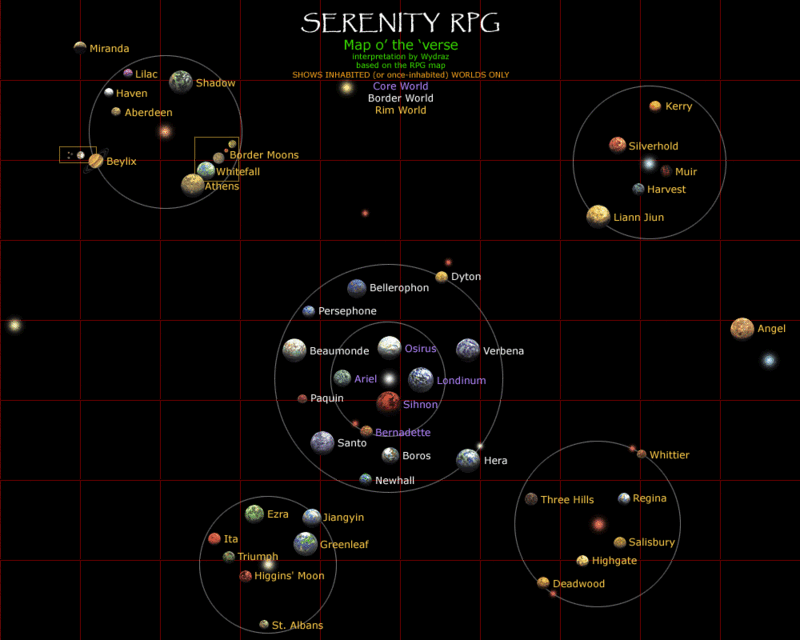
Brian
NOTIFY: Y | REPLY | REPLY WITH QUOTE | PERMALINK | TOP | HOME
Well, that's a little ironic. I made that map! Funny thing is, I made another one based on the QMX version and now have it at my FF RPG page instead of the old one...
http://wydraz.110mb.com/firefly/index.html
(a.k.a. wydraz)
NOTIFY: Y | REPLY | REPLY WITH QUOTE | PERMALINK | TOP | HOME
Wow!!! What a great resource.
I had run across your older map some time ago and I've been using it as my fanfic reference. I just downloaded your interactive version.
The ship class things you have there are cool too.
Your hornet class is almost what I imagined the Rapier class yacht would look like from my "heritage" fanfic.
I guess great minds think alike.
Brian
NOTIFY: Y | REPLY | REPLY WITH QUOTE | PERMALINK | TOP | HOME
Quote:
Originally posted by jewelstaitefan:
You said zseveral light years away. At the speed of light, that would mean several years. At half the speed of light, that would mean twice as much, like 5 or 6 years.
Joss said an entire generation never saw the outside of the ship during exodus to the Verse.
Lifespans have become 120 years in the upcoming 500 years, according to Joss.
So, even if only half light speed, that's about 60-70 light years away.
Not exactly if you take into account relativistic effects.
The difference between subjective and proper time at a constant 0.5c isn't that great, but it is apparent. Assuming it is roughly 120 years subjective time for the journey, that gives you a proper journey time of ~138.5 years.
More likely though you'll be accelerating half way there, and decelerating for the other half.
If you set off in your interstellar Bussard RamJet and kept up a constant acceleration of 1G, you will have travelled 200,000,000 ly in about 200,138,459 Years. However, those on the ship itself would have only experienced 36 and a quarter years.
Assuming the ship could only accelerate at 0.25gees, in roughly 120 years of onboard ship time, the ship could have travelled 20,000,000 ly.
More insane ramblings by the people who brought you beeeer milkshakes!
No one can see their reflection in running water. It is only in still water that we can see.
NOTIFY: Y | REPLY | REPLY WITH QUOTE | PERMALINK | TOP | HOME
So, regarding my post from 4 days ago, does anybody think the discrepancies about orbits, and planets not moving for several months, are intended or are mistakes in Map of the Verse?
Thanks so much for the linkies to the White Paper, and the online version of the Map. That online version seems at a glance to represent or at least mesh well with The Map of the Verse. My White Paper just printed, will have to read it.
I will add these linkies at the beginning of the thread as well.
NOTIFY: Y | REPLY | REPLY WITH QUOTE | PERMALINK | TOP | HOME
The White Paper reveals much of the distance and orbit information. I'll need to go back through this thread and recalculate some things.
Apparently, although Earth travels through it's orbital path at about 6Au per year, Lux only travels at a little over 1Au per year (30.0Au orbit radius, 164 years per orbit). So Georgia might be around the similar speed, and this entire year of Verse we know only adds or subtracts an Au or 2 from planetary travel.
NOTIFY: Y | REPLY | REPLY WITH QUOTE | PERMALINK | TOP | HOME
Another thing that seems weird.
In The Message, Book talks about how Lt Womack is from the Silverhold Colonies, and how very far away it is. Yet on the Map of the Verse, they are relatively very close, in the same system of Red Sun.
Anybody else consider this a contradiction?
NOTIFY: Y | REPLY | REPLY WITH QUOTE | PERMALINK | TOP | HOME
A similar post to this was already done twice, but this is updated with the figures from the White Papaer, so no further revisions should be needed. The previous ones were based on conclusions and measured estimates.
Based upon the White Paper figures, I will recalculate speed and distance figures from an above post.
In the Red Sun system, the orbit of Jiangyin has a radius of 0.525Au, and the orbit of Greenleaf has a radius of 6.900Au.
That gives a distance of 6.375Au when they are nearest, and about 7.725 when farthest from each other (including arcing around the Red Sun itself).
We can assume in Safe that they will use max speed/acceleration when trying to get dying Book to Med Facilities, and this is supposed to be 10 hours. So 5 hours of acceleration,. and 5 hours of decceleration.
The min accel rate would be 0.255 Au/hour sq, and the fastest would be about 0.309 Au/hour sq.
A rudimentary time/distance table would be like this:
Time Min & Max distance/speed
1 hour. 0.1275 @0.255 & 0.1545 @0.309
2 hours. 0.5100 @0.510 & 0.6180 @0.618
3 hours. 1.1475 @0.765 & 1.3905 @0.927
4 hours. 2.0400 @1.020 & 2.4720 @1.236
5 hours. 3.1875 @1.275 & 3.8625 @1.545
6 hours. 4.5900 @1.530 & 5.5620 @1.854
7 hours. 6.2475 @1.785 & 7.5705 @2.163
8 hours. 8.1600 @2.040 & 9.8880 @2.472
9 hours. 10.3275 @2.295 & 12.5145 @2.781
10 hours. 12.7500 @2.550 & 15.4500 @3.090
15 hours. 28.6875 @3.825 & 34.7625 @4.635
18 hours. 41.3100 @4.590 & 50.0580 @5.562
20 hours. 51.0000 @5.100 & 61.8000 @6.180
So it's about 18-20 hours to accelerate until traveled 50Au, then the same to decelerate back to zero, for a total of 36-40 hours to travel 100Au.
please post correction if I have erred.
The speed of light would be approx 7.2Au per hour. Extending the table without consideration of limiting formulae for approaching speed of light, 23 hours would get to 81.7Au distance at velocity 7.1Au/hr at fastest, and 28 hours would get to 99.96Au distance at velocity 7.14Au/hr at slower range of max speed.
White Paper mentioned the average speed of the Exodus to the verse was 1/3 speed of light, but not sure if this is a limitation to extend to 2517.
NOTIFY: Y | REPLY | REPLY WITH QUOTE | PERMALINK | TOP | HOME
Quote:
Originally posted by jewelstaitefan:
The min accel rate would be 0.255 Au/hour sq, and the fastest would be about 0.309 Au/hour sq.
That's a maximum acceleration of ~12840483.8 m/s/s, or 1310253.4g, where 1g is acceleration due to gravity at the Earths surface, roughly 9.8m/s/s.
Solving for a distance of 100AU and assuming constant acceleration then deceleration, that's a trip time of roughly 1.62 Hours.
At that level of acceleration you'd be experiencing relativistic effects too, say on board ship time of about 0.6 hours.
You seem to be scaling your distance traveled linearly. Since the ship is accelerating, distance traveled will actually expand exponentially.
The simple equation for distance travelled per acceleration would be Newtons:
distance = acceleration * time^2
When Jiangyin and Greenleaf are at their furthest, there'll be a star in the way so the greatest travel distance would be somewhat higher than their straight line distance, but ignoring that for a rough figure, I'll take a median between the high and low:
6.375 + 7.725 / 2 = 7.05AU
We need it in metres, which comes out too:
1,054,664,985,621.488m
Time is 10 Hours, 36000 seconds.
Solving the above equation to get acceleration:
d=a*t^2
a=d/t^2
But we're decelerating half way, so we only need to workout half the journey.
Which gives us:
a=527332492810.744 / 18000^2=1627.569422255m/s/s
We want to double that number, because it's only half way, we want to do all our acceleration for half the time, so the final figure is:
~3255.2m/s/s
That's all very rough, but it's more or less what you want. For accelerating half way then decelerating, this will give you a ball park figure:
d=( (a/2)*((t/2)^2) )*2
More insane ramblings by the people who brought you beeeer milkshakes!
No one can see their reflection in running water. It is only in still water that we can see.
NOTIFY: Y | REPLY | REPLY WITH QUOTE | PERMALINK | TOP | HOME
Not sure if we are on the same page, saying the same thing. But our calculations seem to differ.
Quote:
Originally posted by citizen:Quote:
Originally posted by jewelstaitefan:
The min accel rate would be 0.255 Au/hour sq, and the fastest would be about 0.309 Au/hour sq.
That's a maximum acceleration of ~12840483.8 m/s/s, or 1310253.4g, where 1g is acceleration due to gravity at the Earths surface, roughly 9.8m/s/s.
Solving for a distance of 100AU and assuming constant acceleration then deceleration, that's a trip time of roughly 1.62 Hours.
Let's just use the 0.255Au per hour per hour rate which I specified was the minimum accel rate (based upon my calculations - it can be altered if proven to be incorrect). Consider that the assumed given for this problem. After one hour of acceleration, by definition, the craft is at a velocity of 0.255Au per hour. This is the definition, the defined acceleration rate (and decel rate). It will have traveled approx 0.1275Au in that first hour while accelerating from zero velocity up to 0.255Au per hour. Correct so far?
If still accelerating in the second hour, by the end of that second hour, the velocity will have achieved 0.51Au per hour, as defined, right? In that second hour of accelerating from 0.255Au per hour up to 0.5100Au per hour, it traveled approx 0.3825Au, right? Adding that 0.3825 with the 0.1275 from the first hour, the craft will have traveled about 0.5100Au in the first 2 hours of acceleration from zero velocity, correct?
If still accelerating in the third consecutive hour, the velocity will have achieved 0.765Au per hour (0.255Au per hour faster than the 0.51Au per hour it was an hour before), as defined, right? During this 3rd hour, the travel distance while accelerating from 0.51Au per hour up to 0.765Au per hour will proximate 0.6375Au. Added to the 0.51 distance of the first 2 hours, the travel distance of 3 consecutive hours of acceleration would be about 1.1475Au, correct?
I don't see where, if accelerating at 0.255Au per hour per hour, we could achieve a distance of 50Au and also decelerate at the same rate for another 50Au, and complete 100Au in only 1.62 hours.
Possibly your conversion is off? Or both conversions? Not sure, but I don't see your conclusion to fit the given that I stated.
Quote:
At that level of acceleration you'd be experiencing relativistic effects too, say on board ship time of about 0.6 hours.
You seem to be scaling your distance traveled linearly. Since the ship is accelerating, distance traveled will actually expand exponentially.
The simple equation for distance travelled per acceleration would be Newtons:
distance = acceleration * time^2
I'm sorry, this equation does not make real world sense to me. In one unit of time, the square will have been one, and therefore the distance traqveled in your equation is the same as the acceleration rate. Unless the first instant of this time period saw the velocity jump from zero to the acceleration rate velocity (meaning the entire first unit of time was spent AT the velocity, instead of spending that first unit of time accelerating up to that velocity). If it was to accelerate up to 1 Au per unit of time in it's first unit of time, how could it have traveled a full 1 Au in that first unit of time, having started at zero and not exceeded the velocity it needed to achieve by the end of that first unit of time.
This seems incorrect.
Quote:
When Jiangyin and Greenleaf are at their furthest, there'll be a star in the way so the greatest travel distance would be somewhat higher than their straight line distance, but ignoring that for a rough figure,
The shortest distance is when they are closest, assuming nothing in the way, and that is 6.900Au - 0.525Au = 6.375Au. When farthest apart straightline distane - thru Red Sun - is 6.9Au + 0.525Au = 7.425Au. Since Serenity is not capable of traversing the interior of the Red Sun (at least not with it's suspect buffer panels), I conjured substituting a quarter o
NOTIFY: Y | REPLY | REPLY WITH QUOTE | PERMALINK | TOP | HOME
Quote:
Possibly your conversion is off? Or both conversions? Not sure, but I don't see your conclusion to fit the given that I stated.
Possibly, I did it quickly while at work, I'll rerun the numbers later when I have time.
Quote:
I'm sorry, this equation does not make real world sense to me. In one unit of time, the square will have been one, and therefore the distance traveled in your equation is the same as the acceleration rate.
Acceleration provides an exponential increase in distance traveled for linear time, while you're supposition is linear distance for linear time:
Quote:
This discussion illustrates that a free-falling object which is accelerating at a constant rate will cover different distances in each consecutive second. Further analysis of the first and last columns of the data above reveal that there is a square relationship between the total distance traveled and the time of travel for an object starting from rest and moving with a constant acceleration. The total distance traveled is directly proportional to the square of the time. As such, if an object travels for twice the time, it will cover four times (2^2) the distance; the total distance traveled after two seconds is four times the total distance traveled after one second. If an object travels for three times the time, then it will cover nine times (3^2) the distance; the distance traveled after three seconds is nine times the distance traveled after one second. Finally, if an object travels for four times the time, then it will cover 16 times (4^2) the distance; the distance traveled after four seconds is 16 times the distance traveled after one second. For objects with a constant acceleration, the distance of travel is directly proportional to the square of the time of travel.
http://www.glenbrook.k12.il.us/gbssci/phys/Class/1DKin/U1L1e.html
Quote:
I did not intend to average them. We do not know which is correct, where the planets were in relation to each other, so either value could be correct, and any value in between, and I did not want to discount any valid values until other evidence presented itself. The values can be calculated as possible ranges of calculations, and all remains valid.
I know, but I only wanted to run the numbers once, and was really only wanting to show you how to do it, and the pertinent equation, and thought an average of the two extremes would be more useful.
Quote:
I do not know why we need it in meters. But if that works for you, fine. How many Au is traveled in the first hour, by your reckoning?
I'm converting to metres and seconds because those are the units the equation is meant for. You can probably use Hours and AUs if you want, but it makes unit conflicts much more likely.
I'll get back to you in a little while.
More insane ramblings by the people who brought you beeeer milkshakes!
No one can see their reflection in running water. It is only in still water that we can see.
NOTIFY: Y | REPLY | REPLY WITH QUOTE | PERMALINK | TOP | HOME
Ok, so I wasn't deriving the equation properly, chalk it up to running through them quickly at work. The equation is actually:
d=ut+(1/2)at^2
d = distance
u = initial velocity
a = acceleration
t = time
Since the initial velocity, ut is factored out (multiplication by zero = zero). That leaves:
d=(0.5)at^2
Similar to what I had, but I forgot to introduce the 0.5 when I solved the equation. Sorry. That means you're right for the initial hour of acceleration, it'll be half the number found in a. Distance travelled still increases exponentially.
Anyway the equations you want, that will also be easier than constructing a table, are:
a=2d/t^2
t=sqrt[2d/a]
d=(0.5)at^2
Looking back at it now, your table seems close to right, so I may just have misread last time.
More insane ramblings by the people who brought you beeeer milkshakes!
No one can see their reflection in running water. It is only in still water that we can see.
NOTIFY: Y | REPLY | REPLY WITH QUOTE | PERMALINK | TOP | HOME
Quote:
Originally posted by citizen:
... be easier than constructing a table, are:
equations are nice, but I wanted to provide a reference table for others to be able to refer to quicky, without mucking with equations and formulae. As you have adroitly demonstrated, even those who think they are calculating correctly can mistake 1.62 hours for 50 hours.
With so many errors and/or inconsistencies already present in the Map of the Verse, I was hoping to reduce confusion, not multiply confusion, and a table seemed to help rectify this aspect of the confusing parts.
Quote:
your table seems close to right,
I agree.
NOTIFY: Y | REPLY | REPLY WITH QUOTE | PERMALINK | TOP | HOME
Quote:
Originally posted by jewelstaitefan:
As you have adroitly demonstrated, even those who think they are calculating correctly can mistake 1.62 hours for 50 hours.
Well I derived the equation wrong, with the correct equations that appear in my previous post, they're use will be less error prone than using a table.
More insane ramblings by the people who brought you beeeer milkshakes!
No one can see their reflection in running water. It is only in still water that we can see.
NOTIFY: Y | REPLY | REPLY WITH QUOTE | PERMALINK | TOP | HOME
Holy Cow!
Just noticed that Mr. Universe is given the location of Comm Station in ring 2 (Kalidasa orbital ring) in the position Kalidasa plus 150 degrees. If I understand correctly, that is almost the opposite side of the verse from Kalidasa (opposite would be 180 degrees).
If that is the case, then in BDM Serenity goes from Lilac in Blue Sun sytem, to Beaumonde in Kalidasa system, back to Haven in Blue Sun system (both trips don't seem very long), and then the Traingin House and back to Haven (in Blue system) and Miranda in Blue system, and then to Mr Universe, the opposite side of the verse from Kalidasa!! In script (not on screen) River says it will take 4 hours. After luring the reavers, with Alliance/Operative inside the ion cloud of Mr. Universe's place, it did not seem they traveled for several days from Reaver Armada to Mr Universe, to me at least.
Anybody think that is reasonable?
Remember that in OMR it was supposed to take 5-6 days to get from Triumph in Red Sun system to Beaumonde in Kalidasa (implying they were on opposite sides of the verse). And Blue Sun ystem is much farther than Red Sun when on opposite sides of the verse from Kalidasa (or Mr Universe 150 degrees away).
NOTIFY: Y | REPLY | REPLY WITH QUOTE | PERMALINK | TOP | HOME
Based upont the revised information above after the White Paper, we can now review the itineraries of the Verse.
Let's start with BDM Serenity.
Lilac to Beaumonde to Haven to Training House to Haven to Miranda to Mr. Universe's place.
Beaumonde in 15th orbital ring around Kalidasa, which is 121Au from White Sun. Beaumonde is 12.850Au from Kalidasa Sun, so Beaumonde's farthest distance from White Sun is 133.850Au.
Lilac, second moon on New Canaan in 2nd orbital ring around Blue Sun, which is 180Au from White Sun. New Canaan is 2.025Au from Blue Sun, so the nearest distance to White Sun that New Canaan and Lilac get is 177.975Au.
Therefore the shortest distance that Lilac and Beaumonde can get is 44.125Au, or about 24-30 hours at max Serenity acceleration.
Haven, 1st moon on Deadwood in 7th orbital ring around Blue Sun. Deadwood is 14.025Au from Blue Sun, so nearest disance to White Sun would be 165.975Au. Shortest distance from Beaumonde to Haven would be 32.125Au, or about 20-26 hours at max Serenity accel/decel.
Miranda orbiting Burnham around Blue Sun isn't much distance from Haven. Miranda is 0.037Au from Burnham, and Burnham is 23.000Au from Blue Sun (8th orbital ring). So nearest that Miranda gets to Haven is about 8.975Au and farthest apart is about 37.06Au.
Mr. Universe is at Comm Ring 2 Station 2e, in the same orbital ring as Kalidasa (121Au from White Sun) 150 degrees of orbit arc from Kalidasa. At best, this puts it about 190Au from Miranda when Kalidasa is closest to Blue Sun. This also means when the Reaver Armada comes through the ion cloud, it has followed Serenity across the entire verse to surprise the Operative, which doesn't seem to mesh with on-screen.
If Mr. Universe is much closer, then Kalidasa is much farther away, like 120Au if halfway out of closest position to Blue Sun. That 120Au would make it over 40 hours both from Lilac to Beaumonde, and also from Beaumonde to Haven.
So, does this seem reasonable? Or is the Beaumonde distance out of wack? Does it seem reasonable that it took a day to get from Lilac to Beaumonde, and another day to get back to Haven (a short ways from Lilac)?
I didn't get that impression from film and scripts, how about you?
The travels to and from Training House are not a problem, nor are trips to Miranda.
Lemming has admitted that not all of the Map of the Verse is vetted within the series and BDM travel itinerary, so should we decide that this placement of Beaumonde in the Kalidasa System is one of these anomolies?
It would seem that if Beaumonde was in the Blue Sun system, or at least the same system as either Lilac or Haven, then the travel tiems would seem more in line with what the BDM showed.
Anybody else?
One wrinkle to consider is the upgrades to Serenity after TLB and before BDM. Apparently the proceeds from the fencing of the Lassiter paid for all the Serenity upgrades, like more blinking lights around the cockpit, and the new mule. Did they include speed/performance upgrades? Is their travel time quicker now? If so, it's also possible to consider one of the moons of Dragon's Egg as a training House location.
NOTIFY: Y | REPLY | REPLY WITH QUOTE | PERMALINK | TOP | HOME
Another itinerary is for Those Left Behind.
Starting on Constance, next at a dock which could be on Persephone since Badger is there, then someplace where Badger is left, then the site of Battle of Sturges, then to the Training House somewhere around Deadwood.
The Battle of Sturges might be near Sturges, but perhaps not. We can speculate so for initial computations, but cannot assume it is the case. We do not know how the battle was named - for instance, an incident during our recent century could have been named Battle of Bismark, when that ship was tracked, attacked, and finally sunk - it was nowhere near the Dakotas, as an example. Sturges is shown on Map of the Verse as 1st moon on Aphrodite, which is the world in 2nd orbital ring around protostar Murphy, being the 14th orbital ring of Georgia System.
Constance is the 3rd orbital path in Kalidasa System, 1.600Au from it's Sun. So the closest it comes to White Sun is about 119.4Au.
Assuming Persephone is the place Badger shows up, it's orbit is 0.037Au from Lux, which orbits White Sun 30.000Au, so the farthest Persephone gets is 30.037Au from White Sun.
So, the shortest travel distance from Constance to Persephone would be about 89.4Au, or about 35-38 hours of travel, at Serenity's max accel/decel.
Speculating that the Battle of Sturges was near Sturges, with Aphrodite being 0.044Au from Murphy, which orbits 16.000Au around Georgia Sun, the nearest Sturges would get to White Sun would be about 52Au.
So, the shortest travel distance from Persephone to Sturges would be about 22Au, or about 17-19 hours at Serenity's max accel/decel.
Deadwood can get as close as about 166Au to White Sun. So the shortest travel distance from Sturges to Deadwood would be about 114Au, or about 39-43 hours, at Serenity's max accel/decel.
I didn't see much reference to time in TLB, so does this seem like reasonable itinerary estimates to you folk?
NOTIFY: Y | REPLY | REPLY WITH QUOTE | PERMALINK | TOP | HOME
Itinerary for Pilot Serenity.
From Carrier Salvage aroun 0800-0900 to Persephone around 1200, planned stay until 1500 but abrupt departure sooner, then to Whitefall, and possibly on to Boros (not really certain about Boros).
Persephone around Lux is 30.037Au from White Sun at it's farthest reach.
Whitehall is 4th moon on Athens, which is in the 9th orbital ring of the Georgia System. Athens is 8.975Au from Georgia Sun, so is nearest White Sun at about 59Au distance. So at greatest proximity, Persephone and Whitefall are about 29Au apart from each other, or about 19-21 hours travel time at Serenity's max accel/decel.
Boros is the 3rd world in the Georgia System, 1.475Au from it's Sun. So the minimum distance from Whitefall to Boros is about 7.5Au and the max distance is about 10.45Au.
So this max distance would take about 12-13Au to travel at Serenity's max accel/decel.
NOTIFY: Y | REPLY | REPLY WITH QUOTE | PERMALINK | TOP | HOME
Itinerary for The Train Job.
Start off in a Unification Day celebration bar on a moon with 3 worlds in the sky and a ringed body in the background while leaving atmo. Then to Ezra where Niska' Skyplex orbits, then to an unknown place where the towns of Hancock and Paradiso are located.
There are 2 worlds on the Map of the Verse with rings. New Canaan and Beylix. Beylix is closest to Ezra. It could be supposed that St. Lucius is the location of the U-Day bar. Beylix is in the first orbit around protostar Penglai, which is the 11th orbital ring of the Kalidasa Sun. Beylix is 0.028Au from Penglai, which is 8.163Au from it's Sun, so Beylix gets as close as 112.8Au to White Sun.
Ezra is in the 1st orbital position in the Georgia System, 0.350Au from the Sun. This means the farthest Ezra gets from White Sun is about 68.35Au. So the closest Beylix and Ezra get to each other is about 44.5Au, for a travel time of about 24-27 hours at Serenity's max accel/decel.
This does seem out of line with the episode as portrayed. Above Lemming has already admitted that the Map of the Verse did not intend to show a world which was shown in the U-Day bar scene, so perhaps this is just an admitted error on the part of this identification in The Map of the Verse.
NOTIFY: Y | REPLY | REPLY WITH QUOTE | PERMALINK | TOP | HOME
Itinerary for Shindig.
Start on Santo, on to Persephone.
Santo orbits protostar Qin Shi Huang, in the 8th orbital ring around White Sun. With Santo having 0.044Au orbital radius, and QSH 16.312Au orbital radius, the farthest Santo gets from White Sun is 16.356Au.
The closest Persephone gets to White Sun is 29.963Au. So the closest that Santo and Persephone could get to each other is 13.607Au apart. This means a travel time of about 13-15 hours at Serenity's max accel/decel.
NOTIFY: Y | REPLY | REPLY WITH QUOTE | PERMALINK | TOP | HOME
Itinerary for Our Mrs. Reynolds.
Starts on Triumph, planned to go to Beaumonde, should take about 5-6 days.
Triumph orbits protostar Heinlein, which is in the 9th orbital ring of the Red Sun. Triumph is 0.020Au from Heinlein, which is 19.000Au from Red Sun. So the farthest Triumph gets from White Sun is about 87Au.
Beaumonde in the Kalidasa System gets as close as 108.15Au to White Sun. So at greatest proximity, Triumph and Beaumonde get about 21.15Au apart. This would be about 17-19 hours at Serenity's max accel/decel.
This is obviously well within the stated 5-6 day range. This also suggests Red Sun and Kalidasa are nowhere near their nearest orbital paths at this time of the year.
On the other hand, the greatest distance between them will be about 220.87Au. In 5 days (120hours), Serenity can travel 260Au at the slowest range of the max accel (not exceeding 2.5Au, about one third speed of light). This seems to show that not only is Serenity not at max speed, but also Red Sun is about opposite in the system from Kalidasa. Serenity could hit 220Au if traveling 108 hours and only getting to 2.5Au/hr - that's 12 hours less, and could still be referred to as "5 days" travel.
NOTIFY: Y | REPLY | REPLY WITH QUOTE | PERMALINK | TOP | HOME
Itinerary for Out of Gas.
The schedule is to get to Greenleaf in about a week, instead of a route which would normally take only 18 hours, according to Wash.
Greenleaf is 6.900Au from Red Sun. Pelorum on Lux around White Sun can get as far out as 30.06Au, or about 31Au away from Greenleaf at closest distance. Salisbury is 14.350Au from Kalidasa, so gets as close as 106.65Au to White Sun, and 31.75Au from Greenleaf at greatest proximity.
18 hours is about 20.6-25Au distance at Serenity's max accel/decel, so everything outside Red Sun system is outside the 18 hour range - unless Wash was exaggerating.
Greenleaf in the Red Sun system gives an 18 hour travel range out to the 2 protostars of the Red Sun, and the worlds around them. When on opposite sides of their system, they are as far as 26Au away, so they are likely almost on opposite sides of the Red Sun from Greenleaf.
Higgin's Moon is not in this range, but Mal needed to get the Jaynestown merchandise to Bernoulli by the end of that week, so maybe Bernoulli was in on of these worlds of the Red Sun system.
So it is most likely that Out of Gas occured in the Red Sun system.
NOTIFY: Y | REPLY | REPLY WITH QUOTE | PERMALINK | TOP | HOME
Training House location.
With the above listed travel times, we can narrow down the location of the Training House in the BDM - assuming we take Mal's "couple hours" from Haven to Training House, and same to return to Haven, as accurate.
With Haven as first moon on Deadwood, the next nearest planet is Gas Giant Dragon's Egg, and it's 5 Inhabitable moons - closest being about 2.35 Au away, at max proximity. This amounts to about 5-7 hours each way. Deadwood is 14.025Au from Blue Sun, and Dragon's Egg is 11.775Au with farthest orbiting moon another 0.013Au. So it seems none of these moons are where Training House is.
That leaves just Deadwood, the 2nd moon New Omaha, or Haven itself as the location of Training House (according to Map of the Verse.)
Any comments on this?
NOTIFY: Y | REPLY | REPLY WITH QUOTE | PERMALINK | TOP | HOME
Overview/summary of travel/orbital cycles.
Pilot Serenity: Georgia (Athens) is near Lux (Persephone).
Train Job: Kalidasa (Beylix) is near Georgia (Ezra, and maybe Boros or Athens), or else the ringed world of the Teaser was not represented in The Map of the Verse. This is about the same time as Pilot, soon after.
Shindig/Safe: Lux (Persephone) is very far from Red Sun (Jiangyin) and therefore very close to Georgia.
OMR: Red Sun (Triumph) is about opposite position from White Sun to Kalidasa (Beaumonde) - they are very far apart.
TLB: Kalidasa (Constance) is apparently near Lux (Persephone), which is possibly near Georgia (Sturges), and also near Blue Sun (Deadwood).
BDM: Blue Sun (Lilac, Haven, Miranda) is apparently near Kalidasa (Beaumonde).
So, in Pilot Georgia System is near Lux. In Shindig, Lux is about opposite of Red Sun (re: Safe) from the Core, meaning it is very close to Georgia System. This is still. Pilot and Shindig are maybe 2 months or 4 months apart from each other - looks like the orbital cycles keep these protostar and star in proximity for this long.
For OMR, Red Sun is about opposite Kalidasa, so Georgia is very near Kalidasa, and this is October 2517.
For TLB, Kalidasa is near Lux and Blue Sun, and possibly near Georgia. This is considered to be 6 months to 9 months after OMR, and Kalidasa orbits in the opposite direction as Blue Sun. It also seems weird that after telling Inara they are on their way to the Training House (Near Deadwood), they would backtrack to Persephone where Badger shows up.
Regarding TLB and BDM: these occur several months apart in time. Kalidasa and Blue Sun orbit White Sun in opposite directions. The above summary suggests that, several months apart, Kalidasa and Blue Sun are still very near each other while moving opposite in space. Seems like several additional Au of separation will have occurred. Not sure if this is intended, or an oversight mistake on the part of the Map of the Verse - or perhaps Beaumonde is still just not positioned correctly. If Beumonde were placed in Blue Sun system, this would make more sense of the BDM itinerary, and also the OMR itinerary.
The location of Mr Universe and the on-screen travel time from Miranda to Mr Universe seems to imply that Kalidasa is much farther from Blue Sun (Lilac and Haven) than what is also shown on screen - like 120Au, which is several days travel.
NOTIFY: Y | REPLY | REPLY WITH QUOTE | PERMALINK | TOP | HOME

Quote:
Originally posted by GreenFaerie:
Well, that's a little ironic. I made that map! Funny thing is, I made another one based on the QMX version and now have it at my FF RPG page instead of the old one...
http://wydraz.110mb.com/firefly/index.html
(a.k.a. wydraz)
Love your work.

NOTIFY: Y | REPLY | REPLY WITH QUOTE | PERMALINK | TOP | HOME
It has been recently pointed out to me that as of this moment, the White Paper available online has been updated with the data of orbital durations of the 4 Suns around the White Sun. Haven't checked for info on the Kowlon Fed Base or Kowlonshi or Ita Moon.
NOTIFY: Y | REPLY | REPLY WITH QUOTE | PERMALINK | TOP | HOME
The Map of the Verse does not detail the orbital directions of all the worlds, protostars, moons, but only the directions of the 4 Suns orbiting the Core (White Sun). The White Paper also did not, as of the last time I checked.
I had thought there was a standardized formula for the orbital direction of primaries and satellites in celestial mechanics, derived from formation principles, but perhaps I was mistaken.
The terms involved are DIRECT Rotation aka PROGRADE Rotation - meaning rotating in the same direction as the rest of the system, or most of the system, and RETROGRADE Rotation, meaning rotating in the opposite direction as the rest of the system. Apparently Retrograde does not refer to the comparison of a satellite's Primary, but only to the overall System norm.
This is about ACTUAL Retrograde Rotation, as opposed to Apparent Retrograde. Apparent Retrograde refers to how celestial views are observed from Earth's surface (aka astrological or Zodiac retrograde).
For instance, in Earth's Solar System, all of the planets orbit the Sun in a counterclockwise direction, as viewed from a point in space above Earth's North Pole. Our Sun also rotates in this CCW direction.
All planets except Venus also rotate in the same CCW direction, making CCW the Direct Rotation direction. Venus rotates in clockwise direction, making it the only planet with Retrograde Rotation.
Jupiter's largest, inner moons are also CCW, but it's 4 outermost moons, which are smallest, orbit Jupiter CW, making them Retrograde (they ae belived to be "captured" satellites, not originally formed around Jupiter).
Saturn and it's 5 Satellites apparently orbit in a plane more than 90 degrees from the normal plane, making them technically retrograde, but they are all in the same direction of orbit and rotation (one might logically think the satellites would be considered Direct because they follow the lead of their Primary's rotational spin, but they are instead compared to the Solar whole and considered Retrograde).
Also, Pluto is mentioned in places as being Retrograde rotation, but I did not find further explanation - perhaps certain portions of references deleted mention of Pluto after it's demotion, and other parts were not edited.
All of the rest of Earth's Solar System Planets and moons are Direct Rotation both in spin and orbit. Other retrograde rotations are for asteroids and comets.
One helpful reference I found was at this linky, in the paragraph under "Non-planetary Orbit" about halfway down:
http://www.answers.com/topic/orbit
I hope I got all that right. I welcome corrections or further explanations to be posted.
Applications to the Verse:
The Map of the Verse shows that Blue Sun orbits White Sun in a CW direction, and Blue Sun Planets orbit in a plane perpendicular to the Verse's primary plane. The other 3 Suns orbit White Sun in CCW direction.
Although there may be expections, particularly with outermost satellites like moons, it would seem logical to assume that all planetary, Protostar, and moon spin rotations and orbital rotations in the White, Red, Georgia, and Kalidasa Systems are CCW; and Blue Sun could be either, it looks like it might not affect calculations of Verse travel much, so far.
Of course, if at any time Joss, Universal, or QMX make reference in Map or White Paper or other place about a different view, we must defer to the new information. This is just postulated in absence of further data.
Again, please post any corrections or comments.
NOTIFY: Y | REPLY | REPLY WITH QUOTE | PERMALINK | TOP | HOME
If anyone can be benefitted by it, my ARC of the Verse is online here. It's a charted synopsis of the White Paper. Brief, but far less pages.
http://cortexsystemrpg.org/index.php?action=tpmod;dl=item226
NOTIFY: Y | REPLY | REPLY WITH QUOTE | PERMALINK | TOP | HOME
Quote:
Originally posted by citizen:
Also remember that star systems are dynamic, traveling between planet A and Planet B might take three days today, but next month it could be three weeks.
While looking for something else, I ran across this again.
Actually, from data in The White Paper we find that the Verse is fairly static in terms of planetary positions. It does not move very quickly, so distances from one world to another remain quite consistent over many years.
More on this later, when I have more time.
NOTIFY: Y | REPLY | REPLY WITH QUOTE | PERMALINK | TOP | HOME
Quote:
Originally posted by jewelstaitefan:
Based upont the revised information above, we can now review the itineraries of the Verse.
Let's start with BDM Serenity.
Lilac to Beaumonde to Haven to Training House to Haven to Miranda to Mr. Universe's place.
Beaumonde in 15th orbital ring around Kalidasa, which is 121Au from White Sun. Beaumonde is about 13.4Au from Kalidasa Sun, so Beaumonde's farthest distance from White Sun is about 134.4Au.
Lilac, second moon on New Canaan in 2nd orbital ring around Blue Sun, which is 180Au from White Sun. New Canaan is about 2.39Au from Blue Sun, so the nearest distance to White Sun that New Canaan and Lilac get is about 177.6Au.
Therefore the shortest distance that Lilac and Beaumonde can get is about 43.2Au, or about 23-30 hours at max Serenity acceleration.
Haven, 1st moon on Deadwood in 7th orbital ring around Blue Sun. Deadwood is about 14.0Au from Blue Sun, so nearest disance to White Sun would be 166Au. Shortest distance from Beaumonde to Haven would be about 31.6Au, or about 20-26 hours at max Serenity accel/decel.
Miranda orbiting Burnham around Blue Sun isn't much distance from Haven. Miranda about 3.9Au from Burnham, and Burnham about 23.4Au from Blue Sun (8th orbital ring). So nearest that Miranda gets to Haven is about 5.5Au and farthest apart is about 41.3Au (about the saem as Lilac to Beaumonde closest range).
So, does this seem reasonable? Or is the Beaumonde distance out of wack? Does it seem reasonable that it took a day to get from Lilac to Beaumonde, and another day to get back to Haven (a short ways from Lilac)?
I didn't get that impression from film and scripts, how about you?
The travels to and from Training House are not a problem, nor are trips to and from Miranda.
Lemming has admitted that not all of the Map of the Verse is vetted within the series and BDM travel itinerary, so should we decide that this placement of Beaumonde in the Kalidasa System is one of these anomolies?
It would seem that if Beaumonde was in the Blue Sun system, or at least the same system as either Lilac or Haven, then the travel tiems would seem more in line with what the BDM showed.
Anybody else?
One wrinkle to consider is the upgrades to Serenity after TLB and before BDM. Apparently the proceeds from the fencing of the Lassiter paid for all the Serenity upgrades, like more blinking lights around the cockpit, and the new mule. Did they include speed/performance upgrades? Is their travel time quicker now? If so, it's also possible to consider one of the moons of Dragon's Egg as a
training House location.
Still seems clear that Beaumonde location is out of tolerance, it should be in Blue Sun System, based upon all BDH references to it.
Also, wanted to point out a reference I keep forgetting.
In Serenity Vis Comp (written by some Joss guy), on pg 114 Jayne says "Not one day ago" Mal was ready to get rid of River. This is after Training House, referring to Maidenhead on Beaumonde. So then from Beaumonde to Haven (and hours spent there) to Training House takes less than a day, and certainly less than 2 days. This line does not end up in the screen version.
There is also River's line on Miranda, that it will take 4 hours to get to Mr Universe's place from Miranda - this line also does not end up on film.
From Beaumonde in Kalidasa System to Mr. Universe's Comm Station is about 240Au distance, and adding a flyby of Haven in Blue Sun System makes a minimum of 420Au distance. Even if Serenity were able to travel at the Speed of Light, and achieve that velocity very quicky, that's still about 55-60 hours of travel (or 2.5 days). Not even counting all the hours of screen activity. Take a "couple hours" each way from Haven to Training House, this makes 60-65 hours of travel, with Speed of Light Travel. If only half the Speed of Light, this is 115-125 hours. This does not mesh with the time period written by Joss in Jayne's line.
I do understand this is not the greatest reference, but it does show the intent of time displacme
NOTIFY: Y | REPLY | REPLY WITH QUOTE | PERMALINK | TOP | HOME
Quote:
Originally posted by jewelstaitefan:
While looking for something else, I ran across this again.
Actually, from data in The White Paper we find that the Verse is fairly static in terms of planetary positions. It does not move very quickly, so distances from one world to another remain quite consistent over many years.
More on this later, when I have more time.
To be honest I think the Orbital periods in the White Paper are wrong. It looks like they've been extrapolated from the orbital periods of Earth, the Moon and the Gas Giants of the Sol System.
As he notes in the show your working section:
Quote:
Orbital periods are based on Earth for planets and stars, and the Moon for moons and planets around protostars. Since
the protostars were originally super-massive gas giants, it made sense to treat the planets orbiting them as “very large
moons” instead. So, their periods are listed in days instead of years. For those planets, their gas giant or protostar
determines their orbital period.
Some quick back of the envelope calculations for Bernadette show that this isn't an accurate approach. Given the mass of White Sun and the semi-major axis of Bernadette's orbit, the period of that orbit should be about 13.26 Years, yet the White Paper puts it at 23.70 Years.
Orbital mechanics gives exacting relationships, if White Sun is X kg and Bernadette is Y distance, then the orbital velocity HAS TO BE Z m/s, and the Orbital Circumference HAS TO BE PI*(2Y) (well, that's a simplification, but close enough). So either the Mass of White Sun and/or the distance of Bernadette are wrong, or the orbital period is.
Either way how long an orbit takes to complete is largely irrelevant, all the bodies will be travelling at a fairly good speed, and each different orbit has a corresponding different velocity. To see quickly travel times would change you'd need to look at how quickly the bodies relative positions to each other change.
NOTIFY: Y | REPLY | REPLY WITH QUOTE | PERMALINK | TOP | HOME
Quote:
Originally posted by citizen:Quote:
Originally posted by jewelstaitefan:
While looking for something else, I ran across this again.
Actually, from data in The White Paper we find that the Verse is fairly static in terms of planetary positions. It does not move very quickly, so distances from one world to another remain quite consistent over many years.
More on this later, when I have more time.
To be honest I think the Orbital periods in the White Paper are wrong. It looks like they've been extrapolated from the orbital periods of Earth, the Moon and the Gas Giants of the Sol System.
As he notes in the show your working section:Quote:
Orbital periods are based on Earth for planets and stars, and the Moon for moons and planets around protostars. Since
the protostars were originally super-massive gas giants, it made sense to treat the planets orbiting them as “very large
moons” instead. So, their periods are listed in days instead of years. For those planets, their gas giant or protostar
determines their orbital period.
Some quick back of the envelope calculations for Bernadette show that this isn't an accurate approach. Given the mass of White Sun and the semi-major axis of Bernadette's orbit, the period of that orbit should be about 13.26 Years, yet the White Paper puts it at 23.70 Years.
Orbital mechanics gives exacting relationships, if White Sun is X kg and Bernadette is Y distance, then the orbital velocity HAS TO BE Z m/s, and the Orbital Circumference HAS TO BE PI*(2Y) (well, that's a simplification, but close enough). So either the Mass of White Sun and/or the distance of Bernadette are wrong, or the orbital period is.
Either way how long an orbit takes to complete is largely irrelevant, all the bodies will be travelling at a fairly good speed, and each different orbit has a corresponding different velocity. To see quickly travel times would change you'd need to look at how quickly the bodies relative positions to each other change.
I don't know what you consider to be a pretty good speed. Most of the bodies are moving through space at about half an Au per year up to 1.2 Au per year. Comparing the relative positions of the nearest bodies from Core (Pelorum) to Georgia System (Shadow's moons), a 22Au distance gets changed to 25Au over a period of 6 years. Not much of a drastic change in spatiaql position.
Same thing for the gap between Kalidasa (Salisbury) to Blue Sun (Burnham/Miranda or Deadwood). Distance changes from about 45Au to about 48Au over a 6 year period.
Not that big of a difference when navigating the verse.
NOTIFY: Y | REPLY | REPLY WITH QUOTE | PERMALINK | TOP | HOME
Quote:
Originally posted by jewelstaitefan:
I don't know what you consider to be a pretty good speed. Most of the bodies are moving through space at about half an Au per year up to 1.2 Au per year. Comparing the relative positions of the nearest bodies from Core (Pelorum) to Georgia System (Shadow's moons), a 22Au distance gets changed to 25Au over a period of 6 years. Not much of a drastic change in spatiaql position.
Same thing for the gap between Kalidasa (Salisbury) to Blue Sun (Burnham/Miranda or Deadwood). Distance changes from about 45Au to about 48Au over a 6 year period.
Not that big of a difference when navigating the verse.
As I said, I find those figures highly dubious, and running the numbers with well known and experimentally proved equations shows that for the example I tried it was an order of magnitude out.
And half to 1.2 AU a year really isn't that much. Think about Earth's orbit, it has to complete it in one year, and the distance it travels is roughly the circumference of a circle with a radius of 1Au. In other words:
2*PI=6.2831853
Which compares well with converting Earth's average orbital velocity from 29.77km/s to AU a year:
(29.77*31,556,926)/149,598,000=6.279827852
So 1.2AU a year max isn't that fast for an orbital velocity. Even the International space station out does that, it's orbital velocity works out to about 1.6AU a year, and that's in orbit of the relativity weak gravity field of Earth.
NOTIFY: Y | REPLY | REPLY WITH QUOTE | PERMALINK | TOP | HOME
Quote:
Originally posted by citizen:Quote:
Originally posted by jewelstaitefan:
I don't know what you consider to be a pretty good speed. Most of the bodies are moving through space at about half an Au per year up to 1.2 Au per year. Comparing the relative positions of the nearest bodies from Core (Pelorum) to Georgia System (Shadow's moons), a 22Au distance gets changed to 25Au over a period of 6 years. Not much of a drastic change in spatiaql position.
Same thing for the gap between Kalidasa (Salisbury) to Blue Sun (Burnham/Miranda or Deadwood). Distance changes from about 45Au to about 48Au over a 6 year period.
Not that big of a difference when navigating the verse.
As I said, I find those figures highly dubious, and running the numbers with well known and experimentally proved equations shows that for the example I tried it was an order of magnitude out.
And half to 1.2 AU a year really isn't that much. Think about Earth's orbit, it has to complete it in one year, and the distance it travels is roughly the circumference of a circle with a radius of 1Au. In other words:
2*PI=6.2831853
Which compares well with converting Earth's average orbital velocity from 29.77km/s to AU a year:
(29.77*31,556,926)/149,598,000=6.279827852
So 1.2AU a year max isn't that fast for an orbital velocity. Even the International space station out does that, it's orbital velocity works out to about 1.6AU a year, and that's in orbit of the relativity weak gravity field of Earth.
I'm not sure I see where you find a conflict in this.
Clearly, Earth is only 1Au distance, and has approx 6.28Au/year velocity.
But the fastest moving body around the White Sun, thus changing position in the Verse more than any other, is Bernadette. The orbital radius is 8.25Au, and in all of kaylee's life it has not completed an orbit, and in the portion of Kaylee's life that she's been aware of navigation and astronomical positions, Bernadette hasn't even gotten from one side of the Verse to the other (meaning the opposite side of White Sun). So travelling from most places in the Verse to Bernadette produces very little change, even in a decade, let alone a year or month.
Everything else in the Verse takes longer to move that drastically, from one side of the Verse to the other.
Even if you are correct about the orbital periods and velocities being listed a half their formulaic values, that is still not very fast, and the changes in astronomical postions and travel between in this Verse are not very substantial. They are quite minimal, when travelling from one world to another. The only big differences are within a system, where one year it might take 10 hours from one world to another, and the next year it might take only 5 hours. But from one system to another, the difference is negligible.
NOTIFY: Y | REPLY | REPLY WITH QUOTE | PERMALINK | TOP | HOME
Quote:
Originally posted by jewelstaitefan:
Even if you are correct about the orbital periods and velocities being listed a half their formulaic values, that is still not very fast, and the changes in astronomical postions and travel between in this Verse are not very substantial. They are quite minimal, when travelling from one world to another. The only big differences are within a system, where one year it might take 10 hours from one world to another, and the next year it might take only 5 hours. But from one system to another, the difference is negligible.
I don't think they'll all be half the stated value. I'd have to run the numbers to be sure, if you want I'll try to find some time to do it this weekend. Also don't forget that journeys can change drastically not just because the start and end points are in motion, but bodies in between are as well. My feeling is that the distances would change to a greater extent than that specified, but I'd have to check the math to be sure.
NOTIFY: Y | REPLY | REPLY WITH QUOTE | PERMALINK | TOP | HOME
Quote:
Originally posted by citizen:
To be honest I think the Orbital periods in the White Paper are wrong. It looks like they've been extrapolated from the orbital periods of Earth, the Moon and the Gas Giants of the Sol System.
I must agree with you.
I think you are correct about all of the orbital periods listed in the White Paper being wrong.
The orbital periods given in the White Paper do not conform to the laws of astrodynamics.
Quote:
As he notes in the show your working section:Quote:
Orbital periods are based on Earth for planets and stars, and the Moon for moons and planets around protostars. Since the protostars were originally super-massive gas giants, it made sense to treat the planets orbiting them as “very large moons” instead. So, their periods are listed in days instead of years. For those planets, their gas giant or protostar determines their orbital period.
Some quick back of the envelope calculations for Bernadette show that this isn't an accurate approach. Given the mass of White Sun and the semi-major axis of Bernadette's orbit, the period of that orbit should be about 13.26 Years, yet the White Paper puts it at 23.70 Years.
The show-the-work section does describe the reasons for the incorrect figures.
In effect, all orbital periods are calculated assuming all Suns are the same mass as our Sol, but then the Paper and Map lists them with different mass. The laws of astrodynamics do show that with different mass of each Sun, different orbital durations will result.
Your calculation for Bernadette seems fairly accurate, no disagreement there.
Because the White Paper very specifically lists most of these figures such as orbital periods, and there is some implied canon influence because of the people and companies involved, it may be best to consider these to be the "given" data, and adhere to the disemination of this fiction. I suggest we refer to this group of data as "fiction" versions of the peculiar astrodynamics of the Verse. Additionally, to help out others who find these discrepancies and to save them time from blazing this same trail of data collection that we've done, we can refer to actual orbital periods and orbital velocities as the "Science" version of this group of data, based upon laws of astrodynamics present in the rest of the universe.
Quote:
Orbital mechanics gives exacting relationships, if White Sun is X kg and Bernadette is Y distance, then the orbital velocity HAS TO BE Z m/s, and the Orbital Circumference HAS TO BE PI*(2Y) (well, that's a simplification, but close enough). So either the Mass of White Sun and/or the distance of Bernadette are wrong, or the orbital period is.
I had some problem with your post because this passage was confusing, and even now after checking things, it's still confusing.
No disagreement about the orbital circumference being 2 x pi x radius.
To correct the other orbital period figures isn't terribly difficult.
To start with, the orbital periods must be changed by dividing the square root of the mass factor of the central body of the orbit.
The White Sun has mass 3.2 times the mass of our Sol. To correct the orbital period of all Core bodies directly orbiting White Sun, just divide by the square root of 3.2 which is approx 1.79. So Bernadette's given orbital period of 23.7 years can be divided by 1.79 to give 13.24 years as the correct orbital period according to the laws of astrodynamics.
Bodies directly orbiting Georgia Sun should have their given orbital periods divided by the square root of 1.1 or approx 1.05
For Red Sun, the square root of .93 is .96
For Kalidasa, the square root of 1.29 is 1.136
For Blue Sun, the square root of 1.7 is 1.304
The orbital durations for the 4 secondary Suns is a little more complex, because it appears the masses of the 2 Suns must be added and the square root of the sum is the dividing factor. This would also mean that Georgia Sun and Red Sun orbit White sun at different velocities, thus they will eventually collide.
For the orb
NOTIFY: Y | REPLY | REPLY WITH QUOTE | PERMALINK | TOP | HOME
Quote:
Originally posted by jewelstaitefan:
Because the White Paper very specifically lists most of these figures such as orbital periods, and there is some implied canon influence because of the people and companies involved, it may be best to consider these to be the "given" data, and adhere to the disemination of this fiction. I suggest we refer to this group of data as "fiction" versions of the peculiar astrodynamics of the Verse.
Seems reasonable enough, Firefly was never meant to be Hard Science Fiction.
Quote:
I had some problem with your post because this passage was confusing, and even now after checking things, it's still confusing.
No disagreement about the orbital circumference being 2 x pi x radius.
Admittedly it wasn't particularly well written. I'll beg extenuating circumstances being at work and having little time. I was just trying to point out that there's no wriggle room, for a body to be orbiting at a certain distance from a certain mass, it has to orbit at a certain speed.
Quote:
To correct the other orbital period figures isn't terribly difficult.
To start with, the orbital periods must be changed by dividing the square root of the mass factor of the central body of the orbit.
The only thing is that the factors have been brought into question, so while your approach does seem more or less ok, it's introducing a scalar to figures that are incorrect. Now if they're all off by an order of magnitude, rather than being wrong, that's fine, but I was thinking it would be safer too work through the figures from the raw data provided, that's all.
Quote:
Bodies directly orbiting Georgia Sun should have their given orbital periods divided by the square root of 1.1 or approx 1.05
For Red Sun, the square root of .93 is .96
For Kalidasa, the square root of 1.29 is 1.136
For Blue Sun, the square root of 1.7 is 1.304
Don't forget also that all the other stars in the system are said to be orbiting white sun.
Quote:
The orbital durations for the 4 secondary Suns is a little more complex, because it appears the masses of the 2 Suns must be added and the square root of the sum is the dividing factor. This would also mean that Georgia Sun and Red Sun orbit White sun at different velocities, thus they will eventually collide.
I'm not sure what you mean? If Red Sun and Georgia are at the same distance from their orbital centre, they need to be travelling at the same speed?
Quote:
Correct me if I'm wrong, but the orbital period of Persephone around Lux is only 4 days. Is that correct? Persephone has an orbital radius only about one tenth of our Mercury, and Lux has mass of 0.39 times our Sol, and the velocity must be so fast that it must complete an orbit around Lux in 4.16 days.
Actually it comes out for me at about 0.155 Days.
Using the equation derived from Kepler's 3rd Law:
T=2*PI*Sqr[r^3/GM]
Where:
r = Orbital Radius + Star Radius = 6,191,284,000 Metres
M = Gravitational Constant = 6.673x10^-11
G = 0.39xSol Mass = 7.756788x10^32 Kg
T=2 * PI * Sqr[2.373242832x10^29 / (6.673x10^-11 * 7.756788x10^32)]
T=2 * PI * Sqr[2.373242832x10^29 / 5.176104632x10^22]
T=2 * PI * Sqr[4,585,008.397]
T=2 * PI * 2,141.263271
T=13,453.95392 Seconds
T=13,453.95392 / 3600 = 3.73 Hours
T=13,453.95392 / 86,400 = 0.155717059 Days
I've run these numbers a few times with a few different methods and variations, so I'm fairly confident that that value is correct.
Quote:
The assumption that orbital periods for gas giants turned into protostars does not seem valid if the mass figures remain the same between different forms of the same body. Whether a gas giant or protostar, the mass is what established the orbit of the satellites and that is what dictates the orbital period in real world astrodynamics.
That's exactly correct, well mass plus the distance from the gravitational centre.
Quote:
Here your statement is correct, and what I was talking about, but your conclusion is incorrect - the rel
NOTIFY: Y | REPLY | REPLY WITH QUOTE | PERMALINK | TOP | HOME
Quote:
Originally posted by citizen:Quote:
Originally posted by jewelstaitefan:
Bodies directly orbiting Georgia Sun should have their given orbital periods divided by the square root of 1.1 or approx 1.05
For Red Sun, the square root of .93 is .96
For Kalidasa, the square root of 1.29 is 1.136
For Blue Sun, the square root of 1.7 is 1.304
Don't forget also that all the other stars in the system are said to be orbiting white sun.
Did not forget, and clearly pointed this out immediately following:
Quote:Quote:
The orbital durations for the 4 secondary Suns is a little more complex, because it appears the masses of the 2 Suns must be added and the square root of the sum is the dividing factor. This would also mean that Georgia Sun and Red Sun orbit White sun at different velocities, thus they will eventually collide.
I'm not sure what you mean? If Red Sun and Georgia are at the same distance from their orbital centre, they need to be travelling at the same speed?
As I understand the formulae, most circular orbits can be calculated using only the mass of the central (primary) body, because the satellite body is so much smaller as to render it's mass moot. But with these satellite Suns, their mass is sufficeint to require the full formula of the sum of the 2 masses in the calculations.
This means that IF the Georgia Sun and Red Sun were both at the same orbit, they would have different velocities. I think the simplest solution is that Red Sun is actually orbiting at slightly less orbital radius, thus it's velocity is matched to Georgia Sun's velocity at Georgia's orbital radius of 68Au.
Quote:Quote:
Correct me if I'm wrong, but the orbital period of Persephone around Lux is only 4 days. Is that correct? Persephone has an orbital radius only about one tenth of our Mercury, and Lux has mass of 0.39 times our Sol, and the velocity must be so fast that it must complete an orbit around Lux in 4.16 days.
Actually it comes out for me at about 0.155 Days.
Using the equation derived from Kepler's 3rd Law:
T=2*PI*Sqr[r^3/GM]
Where:
r = Orbital Radius + Star Radius = 6,191,284,000 Metres
M = Gravitational Constant = 6.673x10^-11
G = 0.39xSol Mass = 7.756788x10^32 Kg
T=2 * PI * Sqr[2.373242832x10^29 / (6.673x10^-11 * 7.756788x10^32)]
T=2 * PI * Sqr[2.373242832x10^29 / 5.176104632x10^22]
T=2 * PI * Sqr[4,585,008.397]
T=2 * PI * 2,141.263271
T=13,453.95392 Seconds
T=13,453.95392 / 3600 = 3.73 Hours
T=13,453.95392 / 86,400 = 0.155717059 Days
I've run these numbers a few times with a few different methods and variations, so I'm fairly confident that that value is correct.
I was using substitution, not using the numerical givens which you used.
I conjured 1Au radius around 1Sol (of mass) resulted in 1 year.
With .037Au radius (r), and .39Sol (u), cubing .037 and dividing by .39 and then taking the square root gave me 0.011396 years. That gave me 4.16 days.
If it was 1Au radius and .39Sol mass, it would have been 1.6 years of orbital duration.
If it was .037Au radius and 1Sol mass, it would have been 2.6 days.
If it was .37Au (almost Mercury's radius) and 1Sol mass, it would be 82 days (Mercury's is 88 days).
If it was .37Au radius and .39Sol mass, it would be 131.5 days.
The .037 Au is a tenth of .37 and a tenth cubed is a thousandth, and the sqare root of a thousand is about 31, so the reduction of .37Au to .037Au would end up with 1/31st of the duration (orbital period), and 131.5 divided by about 31 is about 4 days.
I have not evaluated why your calculations end up different, I might look into that later. My calculations seem right to me, but maybe I'm missing part of the formula.
Quote:Quote:
The assumption that orbital periods for gas giants turned into protostars does not seem valid if the mass figures remain the same between different forms of the same body. Whether a gas giant or protostar, the mass is what established the orbit of the satellites and that is what dictates the orbital period in
NOTIFY: Y | REPLY | REPLY WITH QUOTE | PERMALINK | TOP | HOME
Quote:
Originally posted by citizen:Quote:
Originally posted by jewelstaitefan:
Correct me if I'm wrong, but the orbital period of Persephone around Lux is only 4 days. Is that correct? Persephone has an orbital radius only about one tenth of our Mercury, and Lux has mass of 0.39 times our Sol, and the velocity must be so fast that it must complete an orbit around Lux in 4.16 days.
Actually it comes out for me at about 0.155 Days.
Using the equation derived from Kepler's 3rd Law:
T=2*PI*Sqr[r^3/GM]
Where:
r = Orbital Radius + Star Radius = 6,191,284,000 Metres
M = Gravitational Constant = 6.673x10^-11
G = 0.39xSol Mass = 7.756788x10^32 Kg
T=2 * PI * Sqr[2.373242832x10^29 / (6.673x10^-11 * 7.756788x10^32)]
T=2 * PI * Sqr[2.373242832x10^29 / 5.176104632x10^22]
T=2 * PI * Sqr[4,585,008.397]
T=2 * PI * 2,141.263271
T=13,453.95392 Seconds
T=13,453.95392 / 3600 = 3.73 Hours
T=13,453.95392 / 86,400 = 0.155717059 Days
I've run these numbers a few times with a few different methods and variations, so I'm fairly confident that that value is correct.
I'm not sure where your numbers come from.
I was using 5.9742 x 10^24 kg as the mass for Earth.
I was using 1.98892 x 10^30 kg as the mass of our Sol.
I think that 0.39 of Sol mass would be 7.4046 x 10^29 instead of 7.756 x 10^32
I don't know why you are adding together the orbital radius plus the radius of the Star - what formula uses that sum? All the equations I've been reading only use the radius from the center of each body, and always define r as being that distance.
White Paper defines radius of Persephone as 5.496 billion meters. Not sure where your figure came from.
NOTIFY: Y | REPLY | REPLY WITH QUOTE | PERMALINK | TOP | HOME
I will jump ahead here now and post some data and resulting conclusions. I understand that there may be some errors in base calculations, but the conclusions end up being similar in the end. If it is determined that the figures are faulty, I can and will return to this post and add corrections. I do welcome any observed errors to be pointed out.
As mentioned previously, data specifically given in Map of the Verse or accompanying White Paper which do not conform to the laws of astrodynamics in the rest of the universe will be referred to as "Fiction" figures. The version of corresponding data derived from adherance to the laws of astrodynamics combined with the other given data in the Map or White Paper will be referred to as the "Science" figures.
Some abbreviation in the left column may be used to attempt column alignment.
T = orbital period (duration)
v = orbital velocity
Body ....T Fiction v ....T Science v
Earth 1 year 6.28Au/yr 1 year 6.28Au/y
Bernadet 23.7yr 2.19Au/yr 13.25yr 3.91Au/yr
Londiniu 27.0yr 2.09Au/yr 15.09yr 3.75Au/yr
PS Lux 164yr 1.15Au/yr 91.9yr 2.05Au/yr
Georgia 561yr 0.76Au/yr 270yr 1.58Au/yr
Red Sun 561yr 0.76Au/yr 276yr 1.55Au/yr
Kalidasa 1331yr 0.57Au/yr 628yr 1.21Au/yr
Blue Sun 2415yr 0.47Au/yr 1091yr 1.21Au/yr
PS Murph 64.0yr 1.57Au/yr 61.0yr 1.65Au/yr
Santo 143day 0.71Au/yr 6.0day 16.9Au/yr
Perseph 121day 0.70Au/yr 4.2day 20.4Au/yr
Pelorum 188day 0.70Au/yr 7.9day 16.4Au/yr
Hera 99.0day 0.69Au/yr 3.2day 21.8Au/yr
Shadow 196day 0.70Au/yr 8.9day 15.4Au/yr
Aesir 55day 0.71Au/yr 1.3day 29.7Au/yr
Anvil 205day 0.69Au/yr 9.1day 15.6Au/yr
Triumph 66day 0.69Au/yr 1.6day 28.1Au/yr
Silvrhld 198day 0.69Au/yr 8.5day 16.2Au/yr
Beylix 91day 0.71Au/yr 3.0day 21.2Au/yr
Oberon 198day 0.69Au/yr 9.5day 14.5Au/yr
Miranda 122day 0.70Au/yr 4.7day 17.9Au/yr
Moon Luna 27.3days to 27.3days
Avalon 27.3days to 32.5days
Rhilidore 27.3days to 24.8days
Summerhom 88.7days to 8.5days
Sweethome 410days to 84.2days
Urvasi 49.1days to 3.9days
7th Circle 546days to 24.6days
NOTIFY: Y | REPLY | REPLY WITH QUOTE | PERMALINK | TOP | HOME
For traqveling around and navigating the verse, there is not going to be much difference between getting to a world orbiting in a system from one month to another, or even till the next year. The fastest directly orbiting body in the Core is Bernadette, and it completes an orbital cycle in 23 years (Fiction) or 13 years (Science). So your navigational adjustments are minimal. Teh body isn't moving all that much, when you're traveling AUs at a pretty good clip.
The greatest differential is going to be from one system to another, and even there most greatest from one world on the edge crossing over to another nearest world on the edge of the nearby system.
Let's consider the 2 greatest differences in distances to travel. They are from the Lux orbit (like Persephone) at the edge of the Core to the Murphy orbit (like Hera, Shadow) at the edge of the Georgia System, and also from Salisbury at the edge of the Kalidasa orbit to the Blue Sun system. Lux and Murphy are closest to each other in 2511 (specified in White Paper). This means that there is practically one line which passes through Georgia Sun, Murphy, Lux, White Sun, and Red Sun at this time.
Although Kalidasa is unlikely to be close to Blue Sun, we will pretend they are and use it as an extreme example. Lux, Georgia, Kalidasa are all in Prograde or Direct Grade orbital direction, and Blue Sun is in Retrograde.
While Lux and Georgia are both in Prograde orbital direction, having Murphy in Prograde orbit means that while it is nearest Lux it is in relative Retrograde - or orbiting away from the shared midpoint between Core and Georgia.
Fiction
Lux velocity is 1.15Au D/year. Goergia system velocity is 0.76Au D/year. Murphy orbital velocity is 1.57Au/year, but it is in relative Retrograde so it's relative verse velocity is 0.81Au R/year.
In a 6 year period, Lux travels 6.90Au through it's orbit. During that period, Murphy trvels away from Lux 4.68Au (opposite direction in the verse). In 2511 they were 22Au apart, and at the end of the 6 year period they are now 24.9Au apart. That is quite insignificant in terms of travel times.
Science
Same thing, with Lux traveling 12.3Au (D) in 6 years, and Murphy moving away .42Au (R) and their combined distance becoming 25.4Au - still minor.
Same thing for Salisbury to Blue Sun.
Fiction
Kalidasa System orbital velocity of .571Au (D)/year, and Salisbury with orbital velocity of 1.657Au (D)/year, adding together for 2.228Au (D)/year. Blue Sun orbits White Sun with velocity .468Au/year Retrograde.
During a 6 year period, Salisbury would distance itself farther from the shared (closest) point by 13.368Au, and Blue Sun would likewise move in the opposite direction 2.808Au in that same 6 year period. Total of 13.368 in sheering difference.
45Au at closest becomes 47.8Au after 6 years.
Science
Kalidasa has 1.21Au (D)/year and Salisbury has 1.88Au (D)/year, for a total of 3.09Au (D)/year. Blue Sun is 1.04Au (R)/year.
45Au at closest becomes 51.4Au after 6 years.
Again, not much difference.
NOTIFY: Y | REPLY | REPLY WITH QUOTE | PERMALINK | TOP | HOME
Quote:
Originally posted by jewelstaitefan:
Did not forget, and clearly pointed this out immediately following:
I didn't really know what you referring to in the following, which is why I didn't pick up on it.
Quote:
Originally posted by jewelstaitefan:
As I understand the formulae, most circular orbits can be calculated using only the mass of the central (primary) body, because the satellite body is so much smaller as to render it's mass moot. But with these satellite Suns, their mass is sufficeint to require the full formula of the sum of the 2 masses in the calculations.
This means that IF the Georgia Sun and Red Sun were both at the same orbit, they would have different velocities. I think the simplest solution is that Red Sun is actually orbiting at slightly less orbital radius, thus it's velocity is matched to Georgia Sun's velocity at Georgia's orbital radius of 68Au.
Well, it's not quite that simple. The problem is that if the gravity of the other object is significant, it's not that it's mass needs to be taken account of for it's orbit, it's that it and the other body are now orbiting a common centre of gravity. Which means an apparent mass between the two bodies, which is the sum of their masses. This point is the barycentre.
The problem is that this means that the orbital radius for Georgia and Red Sun also has to be changed, since they're no longer orbiting White Sun, but White Sun, Georgia, and Red Sun are now orbiting a common centre of gravity.
That's very difficult math.
There's two fair approaches I think. You can either live with a level of simplification by treating the suns as a simple body, just orbiting White Sun (which seems to be how the verse by numbers intends it) or you can try and model the correct orbital mechanics. That last way is going to be incredibly difficult, and you're likely to find the system simply doesn't work.
Another approach might be to fudge the numbers a little, and see if you can't make the total mass of the Red Sun and Georgia systems to be equal, thereby cancelling each other out.
Quote:
I think that 0.39 of Sol mass would be 7.4046 x 10^29 instead of 7.756 x 10^32
You're right sorry. I did the math on the train home, I stupidly wrote up my initial figures that I realised were wrong right after doing them. Looking back at my notes the subsequent figures I used were the right ones, they also actually come out closer to yours. I'd run those a few times and they all came out the same.
Quote:
I don't know why you are adding together the orbital radius plus the radius of the Star - what formula uses that sum? All the equations I've been reading only use the radius from the center of each body, and always define r as being that distance.
Because the tendency is that people give orbital distances as the distance from the surface of the body, rather than the distance from the centre of gravity. In which case the orbital radius is the radius of the star plus the orbital radius. Do you believe that the Orbital distance given is the actual orbital radius? I can use those figures if you prefer:
T=2*PI*Sqrt[1.65989429×10^29/(7.4046x10^29 * 6.673x10^-11)]
T=2*PI*Sqrt[1.65989429x10^29/4.94108958x10^19]
T=2*PI*Sqrt[3359368.95]
T=2*PI*1832.85814
T=355,810.337 Seconds
T=98.8362046 Hours
T=4.11817519 Days
I have to admit I wondered why my figures were so different from yours (which is why I posted them) if I'd turned the page on my notebook I'd have found out. From the figures on my corrections in the notebook, it comes out as 4.92420009 Days, using my distance assumption. Hope that clears everything up.
It's up to you. The proper equation is more accurate, your method seems to get within an order of magnitude. As is obvious I don't have much time to spend on this stuff, if you want to use your method to get a baseline I can run the equation through as and when if you'd like?
Edited for clarity.
NOTIFY: Y | REPLY | REPLY WITH QUOTE | PERMALINK | TOP | HOME
I had not heard of people using distance from the surface of a body as a substitute for radius, all references I have seen were for radius being equal to the distance from one center of mass to the other body's center of mass. Perhaps you work in some field which refers to geo-orbital satellites as being so many miles above the Earth?
My intention had been to point out the magnitude of difference in the White Paper's Fiction values versus the realistic astrodynamic values. We can already accept that the Fiction values could be utilized, and for comparison purposes we can show the values which adhere to laws of astrodynamics. It is possible that the White Paper may update their info with values more similar to "Science" values, so in discussions about these values it seems reasonable to include comparative values to understand the relative validity of conclusions - in many cases, the conclusions will remain virtually the same. Thus further agreement can occur on more issues.
I figured that showing the Fiction value for Persephone as 121 days compares to Science value of 4.2 Days offered adequate contrast. We don't need to detail the added decimal points for these purposes, I just wanted to ensure I wasn't off calculation by the magnitude you had indicated.
Regarding the mass and orbital velocity of the Suns, consider that if the mass of Georgia Sun was a small fraction of White Suns mass, we would use the same formula as the other bodies. I had wanted to use the mass sum figure to help approach what the value would be with so much more mass involved, making the orbital velocity greater than if Georgia was not so massive. The idea of Red and Georgia cancelling each other out is quite useful, but this adds even further the total amount of mass to factor in (adding the mass of Red plus White plus Georgia increased to total gravitational forces), and that would increase the velocity even more. I expect that a fair compomise for our rough guesstimations would be to use the sum of 2 masses to calculate the duration and velocity, and still assume that White is the central body, with all other Suns orbiting it. If we were to not consider it this way, using only one mass (that of White Sun), then the orbital velocity of Georgia will be much slower and the duration (period) will be much more.
Do you find this compromise reasonable? Is it a fair substitution for performing all the exacting mechanical formulae involved?
If you find an error where I indicate something like 4 days and you conjure something like 3 hours, I'd really like to know about vast errors I've created. If you don't, somebody eventually will, and it's best to catch major errors earlier than later.
I have also just filled in more data in my above post regarding travel/navigation changes with examples of Lux, Murphy, Salisbury, Blue Sun. It was rushed and incomplete yesterday, now it's more fleshed out, hope it makes sense.
I have also added more bodies to the table in the post before that. Now included are some of the bodies orbiting protostars and some orbiting Gas Giants. Some of these have a pretty fast clip, and complete full orbits in a day or so.
Clearly, hopping from one of these whizzers to another will have the greatest difference, requiring maybe a half hour one day, and then a full hour the next day. However, to travel TO these bodies from another system, the travel times and navigation are barely changing.
NOTIFY: Y | REPLY | REPLY WITH QUOTE | PERMALINK | TOP | HOME
Quote:
Originally posted by jewelstaitefan:
I figured that showing the Fiction value for Persephone as 121 days compares to Science value of 4.2 Days offered adequate contrast. We don't need to detail the added decimal points for these purposes, I just wanted to ensure I wasn't off calculation by the magnitude you had indicated.
Seems completely reasonable to me.
Quote:
Regarding the mass and orbital velocity of the Suns, consider that if the mass of Georgia Sun was a small fraction of White Suns mass, we would use the same formula as the other bodies. I had wanted to use the mass sum figure to help approach what the value would be with so much more mass involved, making the orbital velocity greater than if Georgia was not so massive.
The point is that if Red Sun and Georgia are orbiting the same centre of gravity at the same distance they have to be orbiting at the same velocity. They're own mass is irrelevent, save to work out what the total mass of the centre of gravity is. The result is for accuracy if you want to include Georgia's mass in the barycentre, you have to include Red Sun's as well, because they're the same orbital system.
I think that might be what you're saying here, but I wasn't 100% sure:
Quote:
I expect that a fair compomise for our rough guesstimations would be to use the sum of 2 masses to calculate the duration and velocity, and still assume that White is the central body, with all other Suns orbiting it. If we were to not consider it this way, using only one mass (that of White Sun), then the orbital velocity of Georgia will be much slower and the duration (period) will be much more.
Do you find this compromise reasonable? Is it a fair substitution for performing all the exacting mechanical formulae involved?
Quote:
If you find an error where I indicate something like 4 days and you conjure something like 3 hours, I'd really like to know about vast errors I've created. If you don't, somebody eventually will, and it's best to catch major errors earlier than later.
It's always best, which is why I always try to show my working as feasible.
NOTIFY: Y | REPLY | REPLY WITH QUOTE | PERMALINK | TOP | HOME
Quote:
Originally posted by citizen:Quote:
Originally posted by jewelstaitefan:
Regarding the mass and orbital velocity of the Suns, consider that if the mass of Georgia Sun was a small fraction of White Suns mass, we would use the same formula as the other bodies. I had wanted to use the mass sum figure to help approach what the value would be with so much more mass involved, making the orbital velocity greater than if Georgia was not so massive.
The point is that if Red Sun and Georgia are orbiting the same centre of gravity at the same distance they have to be orbiting at the same velocity. They're own mass is irrelevent, save to work out what the total mass of the centre of gravity is. The result is for accuracy if you want to include Georgia's mass in the barycentre, you have to include Red Sun's as well, because they're the same orbital system.
I just italicized the term "velocity" in my above quote (I think), to emophasize my meaning. I agree that the Red and Georgia mass will cancel each other in terms of offsetting White's postition as the central body, but those masses must INCREASE the VELOCITY of Georgia and Red, or else their combined Grav force will pull them into a decaying orbit if they're only at the VELOCITY they would be at if 3 times the mass was not involved (Red would pull Georgia into White, and Georgia would pull Red into White).
Quote:
I think that might be what you're saying here, but I wasn't 100% sure:Quote:
I expect that a fair compomise for our rough guesstimations would be to use the sum of 2 masses to calculate the duration and velocity, and still assume that White is the central body, with all other Suns orbiting it. If we were to not consider it this way, using only one mass (that of White Sun), then the orbital velocity of Georgia will be much slower and the duration (period) will be much more.
Do you find this compromise reasonable? Is it a fair substitution for performing all the exacting mechanical formulae involved?Quote:
If you find an error where I indicate something like 4 days and you conjure something like 3 hours, I'd really like to know about vast errors I've created. If you don't, somebody eventually will, and it's best to catch major errors earlier than later.
It's always best, which is why I always try to show my working as feasible.
I'm trying to reduce the info overload here for many, already putting up enough tables and data sets and such. That's also why I listed some tbles, like acceleration of Serenity, so that calculations could be minimized for most readers here. But showing the work is good for finding the discrepancies.
NOTIFY: Y | REPLY | REPLY WITH QUOTE | PERMALINK | TOP | HOME
Quote:
Originally posted by jewelstaitefan:
I just italicized the term "velocity" in my above quote (I think), to emophasize my meaning. I agree that the Red and Georgia mass will cancel each other in terms of offsetting White's postition as the central body, but those masses must INCREASE the VELOCITY of Georgia and Red, or else their combined Grav force will pull them into a decaying orbit if they're only at the VELOCITY they would be at if 3 times the mass was not involved (Red would pull Georgia into White, and Georgia would pull Red into White).
Actually they don't quite cancel out, but we can ignore that as an order of simplification.
I don't understand your objection though. The mass of the satelite isn't important to it's orbital speed, regardless of how massive it is. The Mass of the satelite, if large enough to make a difference, should be used to determine the apparrent mass of the barycentre. If both Georgia and Red Sun are orbiting the same barycentre at the same distance, they have to orbit at the same velocity as each other, that Georgia is more massive than Red Sun is entirely irrelevent to that. Sure they'll be orbiting at a greater velocity than the mass of White Sun would suggest on it's own, but Red Sun and Georgia will have the same velocity.
This is for the same reason that a cannonball and a feather dropped from the same height on the Moon land at the sametime. It's not to do with scale, relative or otherwise, two objects at the same distance from the same gravity centre will always orbit at the same speed, regardless of their own mass.
The apparrent mass of the barycentre, in simplified form ignoring other bodies, will be the sum of White Sun, Georgia and Red Sun. That is the orbital velocity will be a function of a bodies distance from an apparent gravitational centre with the mass of the whole system.
If we ignore the effect Red Sun and Georgia have on White Sun, we assume that there is a barycentre centred on White Sun that is the sum of White Sun's mass, Red Sun's mass and Georgia's mass. Since Georgia and Red Sun are the same distance from this barycentre, they have the same orbital velocity, given by:
v = Sqrt[G(mw+mg+mr)/r]
NOTIFY: Y | REPLY | REPLY WITH QUOTE | PERMALINK | TOP | HOME